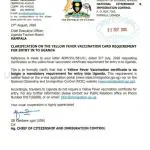
The Ugandan government has announced that travellers entering the country are no longer required to present a Yellow Fever vaccination certificate. This decision was made by the Directorate of Citizenship and Immigration Control, which stated that the certificate is no longer a mandatory condition for entry into Uganda. The move comes after complaints from travellers and tourism stakeholders about alleged extortion and abuse at some border points.
The requirement for a Yellow Fever vaccination certificate had been in place due to Uganda's classification as a high-risk country for Yellow Fever by the World Health Organisation. However, the enforcement of this requirement at some border points had led to reports of officials demanding money from travellers without vaccination cards. In 2023, the Uganda Civil Aviation Authority suspended a dedicated Yellow Fever verification desk at Entebbe International Airport after concerns of abuse.
The suspension of the Yellow Fever verification desk at Entebbe International Airport was due to reports that officials were demanding Yellow Fever certificates from travellers heading to destinations where vaccination was not required. This practice reportedly resulted in "money changing hands." The verification function was subsequently shifted to airline staff during passenger document checks.
Despite the drop in Yellow Fever card requirements, Uganda continues to experience Yellow Fever outbreaks. In 2023, the Ministry of Health, with support from the World Health Organisation and other partners, launched a nationwide preventive vaccination campaign targeting more than 13.3 million people in its first phase. The vaccination drive has since expanded significantly, covering 123 of Uganda's 146 districts and protecting more than 25.8 million people.
The Ugandan government introduced the Yellow Fever vaccine into the country's routine childhood immunisation programme in October 2022. This move was part of efforts to increase population immunity and reduce the risk of future outbreaks. In April 2025 alone, more than 4.2 million people were vaccinated in 19 districts under a campaign that also responded to an active outbreak.
The decision to drop the Yellow Fever card requirement is a significant development, especially for travellers and tourism stakeholders. The move is expected to ease the process of entering Uganda and reduce the risk of extortion at border points. However, travellers are still advised to take necessary precautions against Yellow Fever.
Key efforts to control Yellow Fever in Uganda include a nationwide vaccination campaign and introduction of the vaccine into the routine childhood immunisation programme. Three key points include: the government has protected more than 25.8 million people through vaccination campaigns; Uganda is classified as a high-risk country for Yellow Fever by the World Health Organisation; and travellers to Uganda no longer require a Yellow Fever vaccination certificate for entry.
Key points
- Travellers to Uganda no longer require a Yellow Fever vaccination certificate for entry.
- Uganda has experienced repeated Yellow Fever outbreaks and is classified as a high-risk country by the World Health Organisation.
- The government has protected more than 25.8 million people through vaccination campaigns.