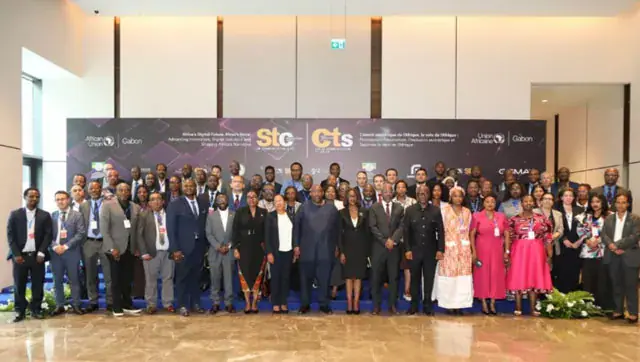
Uganda is participating in the 6th Ordinary Session of the African Union Specialized Technical Committee on Communication and ICT (STC-CICT) in Libreville, Gabon. The high-level forum brings together senior government officials and experts to coordinate policies and advance the continent's digital priorities. For Uganda, the deliberations are crucial for its national digital transformation agenda and economic development. The country's officials believe that the session will provide a platform to align with AU frameworks and safely deploy artificial intelligence (AI) across public sectors.
The STC-CICT session comes at a strategic juncture as the theme of the upcoming 34th AU Summit in January 2027 is "AU at the Dawn of its 25th Anniversary: Leveraging the Full Potential of SAATM & New Technologies for Continental Integration." The STC-CICT outcomes are expected to directly inform the ministerial decisions that will shape this summit, making Uganda's participation vital for shaping the continental agenda on digital trade and infrastructure. Uganda's officials said that aligning with AU frameworks will enable the country to mitigate algorithmic bias and secure its data sovereignty.
Uganda is transitioning toward developing its own AI capabilities, supported by the Aeonian Project's supercomputing infrastructure powered by domestic hydropower. The country's delegation will focus on ensuring that the resulting recommendations are practical and responsive to the realities of all Member States. By actively participating, Uganda ensures that its domestic investments in digital infrastructure, AI technologies, and local data center capabilities remain scalable, secure, and globally competitive.
In his opening remarks, Dr. Kamugisha Kazaura, Director of Infrastructure and Energy at the African Union Commission, underscored the strategic importance of emerging technologies. He stated that connectivity, secure data exchange, and interoperability are foundations for integrated public services and digital innovation. Dr. Kazaura called for practical technical recommendations to inform ministerial decisions.
The harmonization of e-government standards at the AU level will ensure that Uganda's public digital architecture integrates seamlessly with regional immigration and trade systems. Aligning with the AU's Digital Transformation Strategy for Africa strengthens Uganda's position to secure international financing and establish cheaper, more robust cross-border fiber-optic linkages. This is a key objective of the National Backbone Infrastructure (NBI) and UCUSAF projects.
As the session elects a new Bureau, chaired by Ghana with Kenya as First Vice-Chair, Uganda's delegation will be focused on ensuring that the resulting recommendations are practical and responsive to the realities of all Member States. The outcomes of this session will ultimately contribute to the continental strategies that will define Africa's digital future.
The African Union said that the outcomes of this session will ensure that Uganda's tech startups can scale across borders under the African Continental Free Trade Area (AfCFTA) without facing fragmented regulatory barriers. By aligning with AU frameworks, Uganda aims to safely deploy AI across public sectors, mitigate algorithmic bias, and secure its data sovereignty while transitioning from external hosting to local Tier III data centers.
Key points
- Uganda participates in 6th AU STC-CICT Session to accelerate national digital transformation agenda
- Session outcomes to inform ministerial decisions at 34th AU Summit in January 2027
- Uganda aims to safely deploy AI across public sectors, mitigate algorithmic bias, and secure data sovereignty