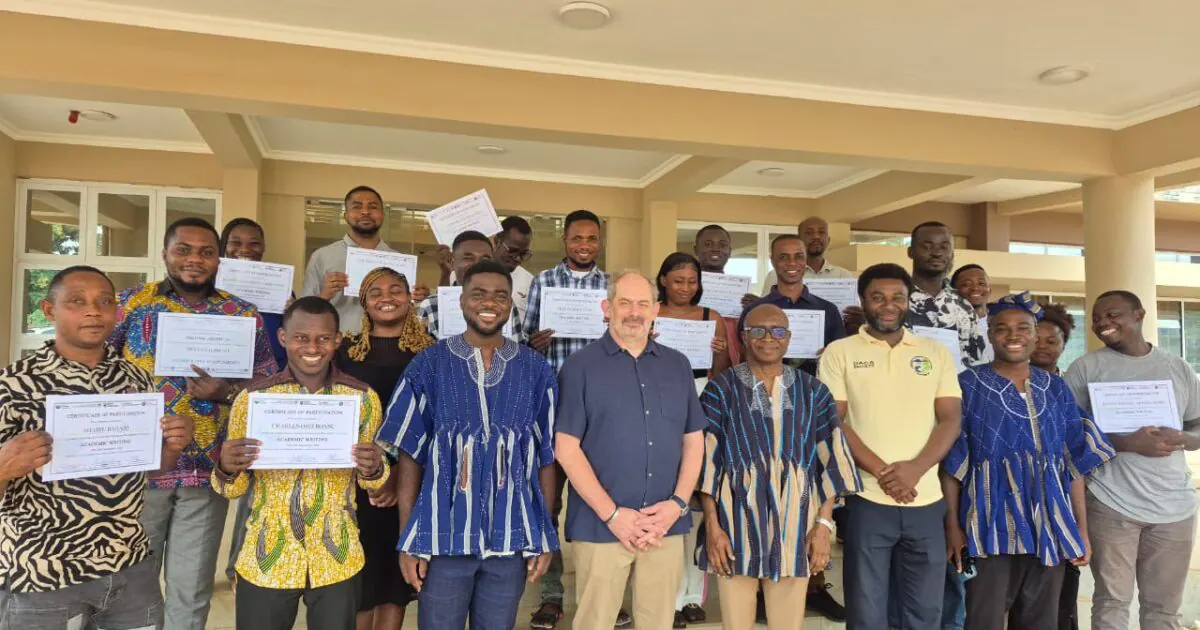
The University of Energy and Natural Resources (UENR) recently collaborated with Lancaster University in the United Kingdom to host a two-day academic writing workshop. The event, which took place from 19 to 20 September 2026, was held at the RCEES Lecture Hall 1 and brought together postgraduate students and researchers. The workshop aimed to enhance participants' skills in producing and communicating high-quality research. Organised by the Department of Atmospheric and Climate Science (DACS), the programme was part of activities towards establishing the Centre for Global Eco-Innovation (CGEI) at UENR.
The workshop covered essential topics such as the development and structure of academic papers, presentation of research findings, scholarly communication, publication practices, and research ethics. Rather than relying solely on lectures, the programme included discussions and practical exercises designed to allow participants to apply the principles being taught to academic writing. This approach enabled participants to engage actively with the material and gain hands-on experience. The training was facilitated by Professor Kirk T. Semple, Director of International Research at Lancaster University and Visiting Professor at UENR.
Professor Semple was joined by other notable facilitators, including Dr Nana Agyemang Prempeh, Head of DACS, Dr Frederick Otu-Larbi, Director of the Centre for Global Eco-Innovation at UENR, and Dr Caleb Mensah, a Senior Lecturer at DACS. The Vice-Chancellor of UENR, Professor Elvis Asare-Bediako, also supported the programme and participated in the activities. His involvement provided encouragement to both the facilitators and participants and highlighted the university's focus on strengthening research capacity and creating opportunities for professional development.
The academic writing workshop is part of the wider collaboration between UENR and Lancaster University and the planned development of the Centre for Global Eco-Innovation. The proposed centre is expected to support collaboration between researchers, facilitate knowledge exchange, and strengthen research-driven responses to global environmental and sustainability challenges. This initiative links researcher development with the broader effort to build a stronger research and innovation ecosystem at UENR.
For UENR, the training comes as the university works to deepen its research links with Lancaster University and build the capacity of researchers and postgraduate students. The organisers say similar professional development programmes are expected to be extended to other parts of the university in subsequent editions. This move demonstrates UENR's commitment to enhancing the skills and competencies of its researchers and postgraduate students.
The Centre for Global Eco-Innovation at UENR is expected to provide a platform for research collaboration, knowledge exchange, and innovation in response to environmental and sustainability challenges. The centre's establishment is a significant step towards fostering a culture of research and innovation at UENR. By providing researchers with the necessary skills and support, the university aims to contribute to addressing global environmental and sustainability challenges.
The collaboration between UENR and Lancaster University reflects the growing importance of international partnerships in research and innovation. By working together, institutions can share knowledge, expertise, and resources to address common challenges. The academic writing workshop is a testament to the potential of such partnerships to enhance research capacity and promote academic excellence.
Key points
- The University of Energy and Natural Resources (UENR) has held a two-day academic writing workshop in collaboration with Lancaster University to strengthen postgraduate students' and researchers' ability to produce and communicate high-quality research.
- The workshop covered essential topics such as academic paper development, research findings presentation, and scholarly communication.
- The initiative is part of the establishment of the Centre for Global Eco-Innovation at UENR, which aims to support research collaboration, knowledge exchange, and innovation in response to environmental and sustainability challenges.