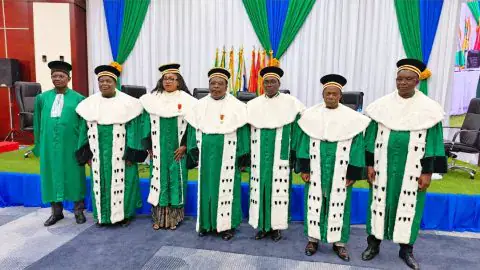
The Court of Justice of the West African Economic and Monetary Union (UEMOA) has marked its 30th anniversary, with its president, Kuami Gameli Lodonou, calling for a profound transformation of the institution. The anniversary coincides with the start of the 2026-2027 judicial year. Lodonou emphasized the need for a new judicial revolution that prioritizes the needs of the people. He outlined several key areas for reform, including improving access to justice, strengthening institutional capacity, and modernizing the court's operations.
Established in 1994, the Court of Justice has played a crucial role in promoting the rule of law within the UEMOA. The court was formally installed on January 27, 1995, in Ouagadougou. Over the past three decades, it has developed a robust regulatory framework and jurisprudence. The court's mandate includes ensuring the legality of community acts, providing redress for citizens, and interpreting community law. Lodonou acknowledged the court's progress, highlighting its role in shaping various aspects of economic integration law.
The Court of Justice has rendered numerous judgments, advisory opinions, and orders since its inception. Its jurisprudence has contributed significantly to the development of economic integration law in areas such as competition, public service, and customs. Lodonou attributed the court's achievements to the collective efforts of its members, past and present, as well as its staff. He acknowledged that the court's evolution has not been without challenges but has allowed it to gain experience and maturity over time.
To improve access to justice, Lodonou proposed popularizing the preliminary reference mechanism, enabling individuals to directly petition the court. He also advocated for clarifying the court's competencies in protecting fundamental rights. This would provide a clearer legal basis for the jurisdictional guarantees outlined in the UEMOA treaty. Lodonou emphasized that these reforms would bring the court closer to citizens and enhance its effectiveness.
Strengthening the court's capacity to respond to growing demands for community justice is another key area of focus. Lodonou suggested increasing the court's personnel and exploring the possibility of a two-tiered judicial system. This would reinforce guarantees of a fair trial, in line with principles enshrined in the African Charter on Human and Peoples' Rights. However, he acknowledged that these ambitions must be balanced against the financial constraints facing the union.
Modernizing judicial procedures is also a priority, with Lodonou stressing the need for greater transparency, quality, and efficiency in the court's operations. He announced plans to leverage technology and artificial intelligence to enhance the court's performance. The court aims to adapt to the changing needs of the community and provide better services to citizens.
As the Court of Justice looks to the future, Lodonou emphasized the importance of engaging in a new institutional dynamic. The court's transformation will require careful consideration of the challenges and opportunities facing the UEMOA. With its 30th anniversary marking a significant milestone, the court is poised to enter a new era of growth and development, with a renewed focus on serving the needs of the people.
Key points
- The Court of Justice of the UEMOA has marked its 30th anniversary, with its president calling for a new judicial revolution to improve access to justice and modernize the institution.