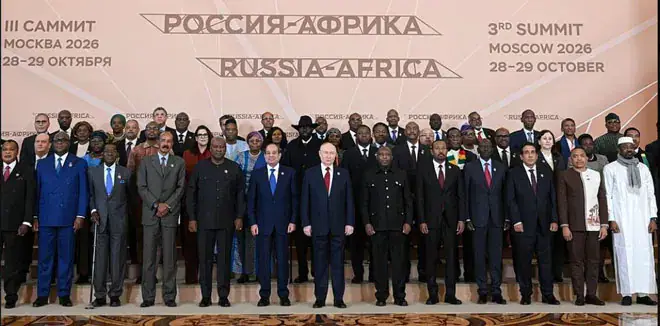
The third Russia-Africa Summit, held on October 28-29, brought together Russian President Vladimir Putin and a carefully assembled group of African leaders and representatives of the continent's major institutions. The gathering was co-chaired by Putin and Burundi's President Évariste Ndayishimiye, who was also attending in his capacity as the current Chairperson of the African Union (AU). The attendance was broad, with representatives of almost 50 African countries taking part, including heads of state and government and senior officials.
The summit included top leaders and representatives from the African Union Commission, the African Continental Free Trade Area (AfCFTA), the East African Community (EAC), the Common Market for Eastern and Southern Africa (COMESA), the Economic Community of Central African States (ECCAS), the Intergovernmental Authority on Development (IGAD), and the Southern African Development Community (SADC). This institutional representation was significant, as Russia engaged with the structures through which African countries coordinate trade, diplomacy, and regional development.
The summit's theme was "For Peace, Security and Development," and its central political message was the need for a multi-polar world in which African countries exercise greater influence and are not treated as subordinate to powerful states. Putin presented Russia as a longstanding partner in Africa's struggle against colonialism and in the continent's pursuit of independence. He invoked the legacy of Tanzania's first president, Julius Nyerere, recalling his words that "independence means relying on one's own strength."
The summit's final declaration, adopted on October 29, reaffirmed the principles of the UN Charter, sovereign equality, territorial integrity, and non-interference in the internal affairs of states. It also called for a more balanced international order and opposed what it described as contemporary forms of colonialism. For African leaders, these principles are familiar and important, but the challenge is ensuring that they apply consistently in practice, including in relations with powerful partners.
President Ndayishimiye used his position as AU Chairperson to reiterate Africa's desire to diversify its partnerships and strengthen its own capacity. He welcomed the summit's political declaration and the new Russia-Africa Partnership Forum Action Plan for 2027–2029, describing the plan as an operational framework for the next three years. However, he also made clear that political solidarity alone would not be enough, and that Africa's young people expect tangible results from the implementation of these documents.
Ndayishimiye called for a shift away from a relationship centred largely on the exchange of commodities, and instead emphasized the need for greater value addition, stronger regional value chains, transport links, healthcare cooperation, and technology transfer. The objective should be creating a partnership that supports industrial development rather than simply expanding trade in raw materials. This emphasis on implementation was one of the summit's most important themes.
The question for observers is whether the political warmth and institutional activity can translate into practical gains for African economies and the 1.3 billion African citizens. African leaders are not approaching external partnerships as passive recipients, but rather have their own priorities and are increasingly seeking arrangements that support regional integration, economic transformation, and greater control over strategic resources. The Russia-Africa relationship needs to produce visible improvements in people's lives, including scholarships, more ambitious energy initiatives, and digital solutions.
Key points
- The summit aimed to deepen ties between Russia and African governments and institutions.
- African leaders are seeking tangible results from partnerships, including greater value addition and industrial development.
- The Russia-Africa relationship needs to produce visible improvements in people's lives, including scholarships, energy initiatives, and digital solutions.