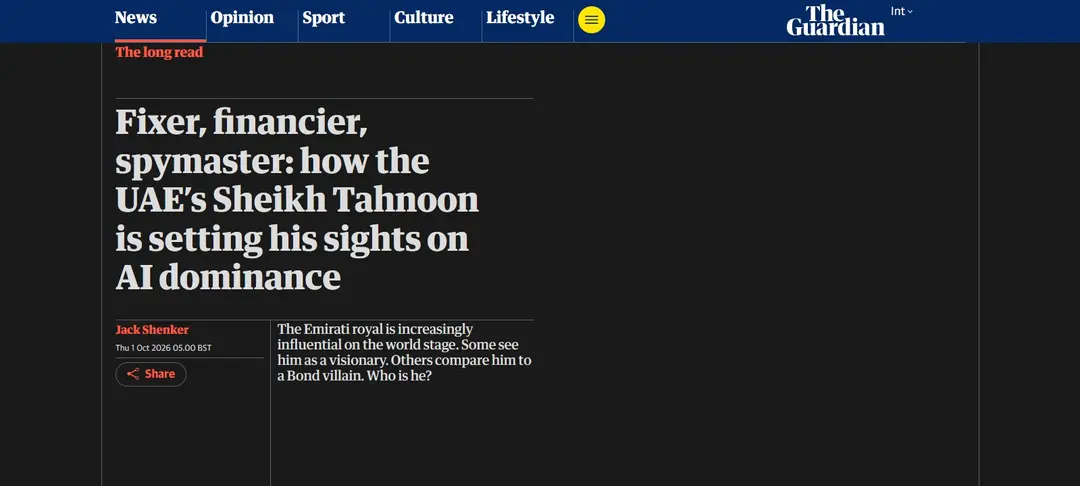
A recent investigation by The Guardian has uncovered a complex web of practices and allegations associated with the United Arab Emirates (UAE). The probe reveals a history of electronic espionage, targeting of critics, and concentration of wealth and influence within circles connected to the ruling family. Furthermore, the UAE faces accusations of interfering in foreign conflicts and involvement in highly sensitive matters, including the conflict in Sudan.
At the center of the investigation is the UAE's "Raven" electronic espionage program, established under the guise of counter-terrorism efforts. However, it evolved into a tool for extensive digital surveillance, targeting Emirati nationals deemed disloyal, as well as activists, journalists, and political figures outside the UAE. The program allowed operators to gather information and infiltrate the devices of individuals not necessarily linked to direct security threats, effectively making electronic espionage a means to pursue critical voices.
The investigation highlights the role of Sheikh Tahnoun bin Zayed Al Nahyan, the UAE's National Security Adviser, in expanding these capabilities. Following the normalization of relations between the UAE and Israel, Abu Dhabi gained access to the "Pegasus" program. This software can infiltrate "Apple" and "Android" devices without users' knowledge, converting them into surveillance tools. The investigation names several individuals targeted or believed to have been targeted by these tools, including former British Prime Minister Boris Johnson.
The case of British researcher Matthew Hedges, arrested in the UAE in 2018, exemplifies the extent of these practices. Hedges claims he was subjected to solitary confinement, prolonged interrogations, forced medication, and threats against his family while conducting academic research on the UAE's national security strategy. After his release, he allegedly faced a smear campaign, including the publication of a 19-page file containing personal information.
The investigation also explores the connection between security agencies and companies involved in these practices, notably "DarkMatter," linked to the "Raven" program. Following the disbandment of DarkMatter, its personnel and capabilities transitioned to "G42," a leading technology company in the UAE. G42 offers technologies including immediate threat defense, suspect classification, and behavior analysis, raising concerns about the evolution of electronic espionage into artificial intelligence applications.
The probe further reveals a significant concentration of wealth and economic influence within a circle associated with Sheikh Tahnoun bin Zayed. The "Royal Group" has become a primary investment vehicle for his interests, with estimated assets of around $300 billion. The overall economic empire under his supervision is estimated to be approximately $1.5 trillion, encompassing investment funds, banks, and various economic sectors. This concentration of resources raises questions about the boundaries between personal, familial, and state assets.
The UAE also faces serious allegations of external interference. According to The Guardian, Abu Dhabi has supported armed and semi-military groups in Yemen, Libya, Ethiopia, and Sudan, with these interventions often linked to high levels of violence against civilians. In Sudan, the UAE is accused of complicity in actions that could be considered genocide, marking one of the most severe allegations against the UAE in the context of the Sudanese conflict.
Key points
- The UAE's extensive surveillance and interference activities have raised significant concerns internationally.
- The concentration of wealth and influence within circles connected to the UAE's ruling family has sparked questions about governance and accountability.
- The UAE's involvement in foreign conflicts, particularly in Sudan, has led to accusations of complicity in serious human rights abuses.