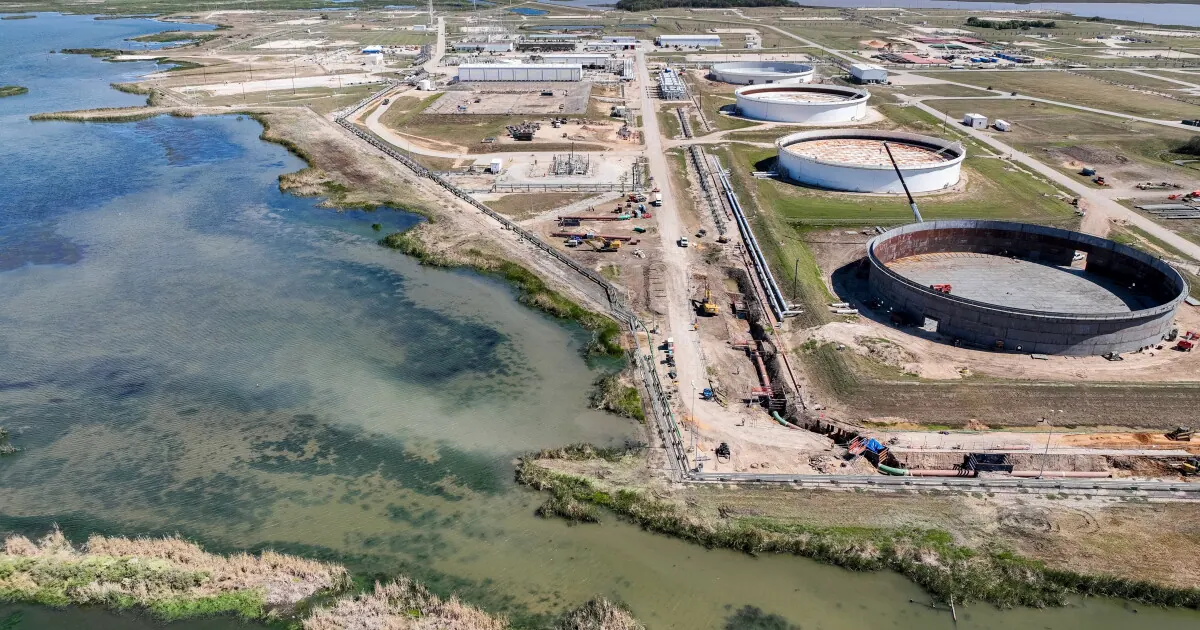
The U.S. Strategic Petroleum Reserve, a critical emergency stockpile of crude oil, has dwindled to less than 285 million barrels, its lowest level since the early 1980s. This significant decline comes as the global oil market faces unprecedented challenges, including the ongoing conflict in Iran, which has led to a substantial increase in oil prices. The reserve's current state has raised concerns among energy experts and policymakers about the country's ability to respond effectively to future energy crises.
The rapid depletion of the Strategic Petroleum Reserve is attributed to the Trump administration's efforts to mitigate the impact of high gasoline prices by releasing oil from the stockpile multiple times since the conflict in Iran began in late February. While the reserve held around 415 million barrels of oil in February, it has shrunk by more than 30% in just six months. This accelerated drawdown has sparked warnings about the potential risks to the salt caverns' structure, where the oil is stored, and the broader implications for energy security.
Energy experts, including Samantha Gross, director of the energy security and climate initiative at the Brookings Institution, have expressed concerns about the physical risks associated with rapidly depleting the reserve. Gross notes that as the reserves get lower, the facilities can become degraded, potentially causing damage if too much oil is pumped out. Additionally, there are economic risks to consider, as the ongoing conflict in Iran has led to a significant decrease in global oil stockpiles, making it more challenging for the U.S. to replenish its reserves.
The Trump administration has explored alternative measures to address the energy crisis, including a partnership with an oil company in Venezuela, which will grant the U.S. a majority stake in 17 Venezuelan oil fields. The White House has stated that this deal will ensure a stable supply of low-cost oil, potentially facilitating the refilling of the Strategic Petroleum Reserve. However, experts have raised questions about the feasibility of using Venezuelan oil to replenish the reserve, given the country's oil production challenges and the quality of its crude oil.
A significant challenge in utilizing Venezuelan oil is its heavy and dense nature, with high sulphur levels, which may not be suitable for the U.S. Strategic Petroleum Reserve. Much of the oil in the reserve is lighter, with medium or light levels of sulphur, making it more suitable for producing gasoline and diesel. The U.S. may need to engage in a swap with Venezuela, exchanging lighter crude for heavier Venezuelan oil, but this process is likely to be complex and time-consuming.
The development of new oil fields in Venezuela will require significant investment and infrastructure development, potentially taking years or even decades to come online. According to Jorge León, head of geopolitical analysis at Rystad Energy, some oil fields will need to be developed from scratch, while others will require reinvestment and redevelopment. Francisco Monaldi, director of the Latin American Energy Program at the Baker Institute, estimates that it may take 10 to 20 years for oil production to begin in some of these fields.
Energy experts suggest that the U.S. can learn from China's approach to managing its strategic oil reserves. China, which has the largest oil stockpiles in the world, has dipped into its reserves since the Iran conflict began but has done so at a more measured pace. China's growing fleet of electric vehicles has helped reduce its reliance on oil, with electric transport displacing demand for at least 1.5 million barrels of oil per day. Some experts argue that reducing demand for oil, through measures such as promoting electric vehicles, may be a more effective long-term strategy for managing energy security risks.
Key points
- The U.S. Strategic Petroleum Reserve has dropped to its lowest level since the 1980s.
- The rapid depletion of the reserve poses risks to energy security and the country's ability to respond to future crises.
- The U.S. is exploring alternative measures, including a partnership with Venezuela, to replenish the reserve.