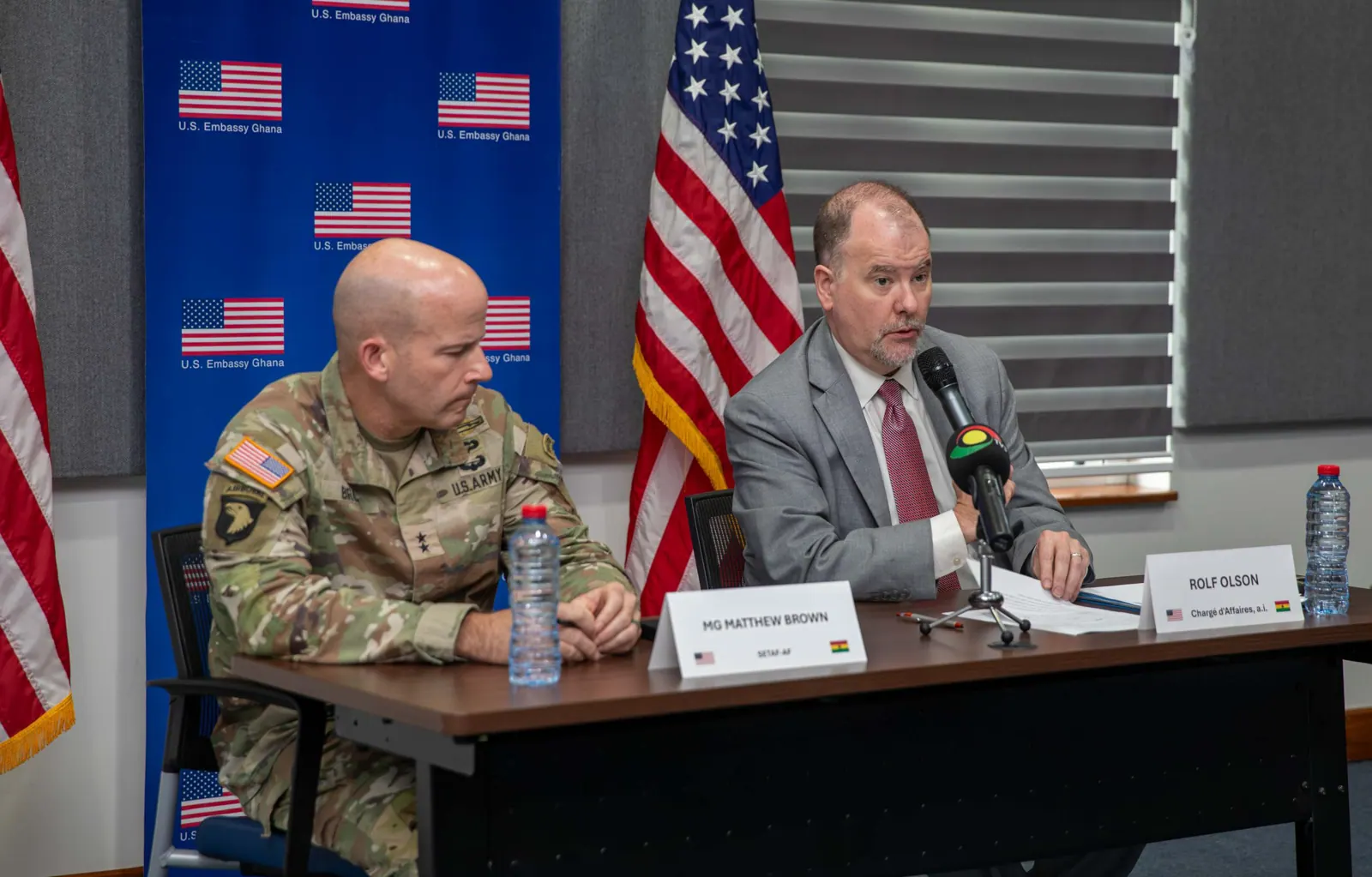
The United States is seeking a gradual transition from long-term health assistance to greater country ownership and self-reliance. Mr. Rolf Olson, Chargé d’Affaires of the U.S. Embassy in Accra, stated that this approach aims to help countries progressively assume responsibility for financing and managing their health programs rather than remaining dependent on external assistance. This approach is part of a broader shift in U.S. foreign assistance policy towards multi-year, co-investment agreements intended to strengthen the health sovereignty of partner countries.
The proposed bilateral health Memorandum of Understanding (MOU) between Ghana and the United States forms part of this shift in policy. Mr. Olson explained the thinking behind the proposed MOU during a media roundtable with selected journalists in Accra. The MOU is intended to provide a structured and measured pathway for Ghana to transition from external support towards greater ownership. The U.S. Administration released the America First Global Health Strategy in September 2025, which seeks to strengthen bilateral relationships through multi-year co-investment agreements.
The U.S. State Department has signed 35 bilateral global health MOUs, including 24 with sub-Saharan African countries, involving $24.6 billion in new health funding. More than $14.5 billion represents U.S. assistance, while over $10.1 billion constitutes co-investment from recipient countries. These agreements aim to strengthen the sovereignty of partner countries and gradually move them towards greater responsibility for their health systems. The U.S. believes that health assistance should ultimately help countries develop the capacity to take responsibility for their own health systems.
The proposed MOU with Ghana is designed to gradually reduce U.S. health assistance over several years while allowing Ghana to strengthen its capacity to finance and manage its own health programs. Mr. Olson emphasized that the approach prioritizes "trade over assistance, and opportunity over dependency." The U.S. invested $82.5 million in Ghana during the first year of the new U.S. Administration and a further $53 million in Fiscal Year 2026. A final multi-million-dollar installment for Fiscal Year 2027 is also being considered.
Ghana's President John Dramani Mahama recently stated that some conditions attached to the proposed health compact were unacceptable, leading to the country's decision to reject the agreement. The proposed agreement required Ghana to provide the United States with its pathogen profile and medical records and to commit a specified amount of counterpart funding. President Mahama also noted that the agreement contained provisions under which medicines and other medical products supplied under the program would not be subject to inspection by Ghana's Food and Drugs Authority.
The development has brought renewed attention to Ghana's dependence on external financing for key health programs and the need to strengthen domestic capacity to sustain those programs. President Mahama has advocated for greater health self-reliance under the Accra Reset initiative, including increased domestic production of medicines and vaccines, stronger research capacity, and health systems that are less dependent on external financing. Mr. Olson stated that the United States remains proud of its contribution to Ghana's health sector and the impact of its investments over the years.
U.S. health assistance has contributed to significant improvements in health outcomes in Ghana, including a substantial decline in disease prevalence. The U.S. President's Emergency Plan for AIDS Relief (PEPFAR), established over two decades ago, is an example of an emergency response that has evolved into a long-running global health program. Mr. Olson cited PEPFAR as an example of the need for countries to eventually transition from external support towards greater ownership.
Key points
- The United States is seeking a gradual transition from long-term health assistance to greater country ownership and self-reliance in Ghana.
- The proposed bilateral health MOU between Ghana and the United States aims to provide a structured pathway for Ghana to transition from external support towards greater ownership.
- Ghana's decision to reject the proposed health compact has brought renewed attention to the country's dependence on external financing for key health programs.