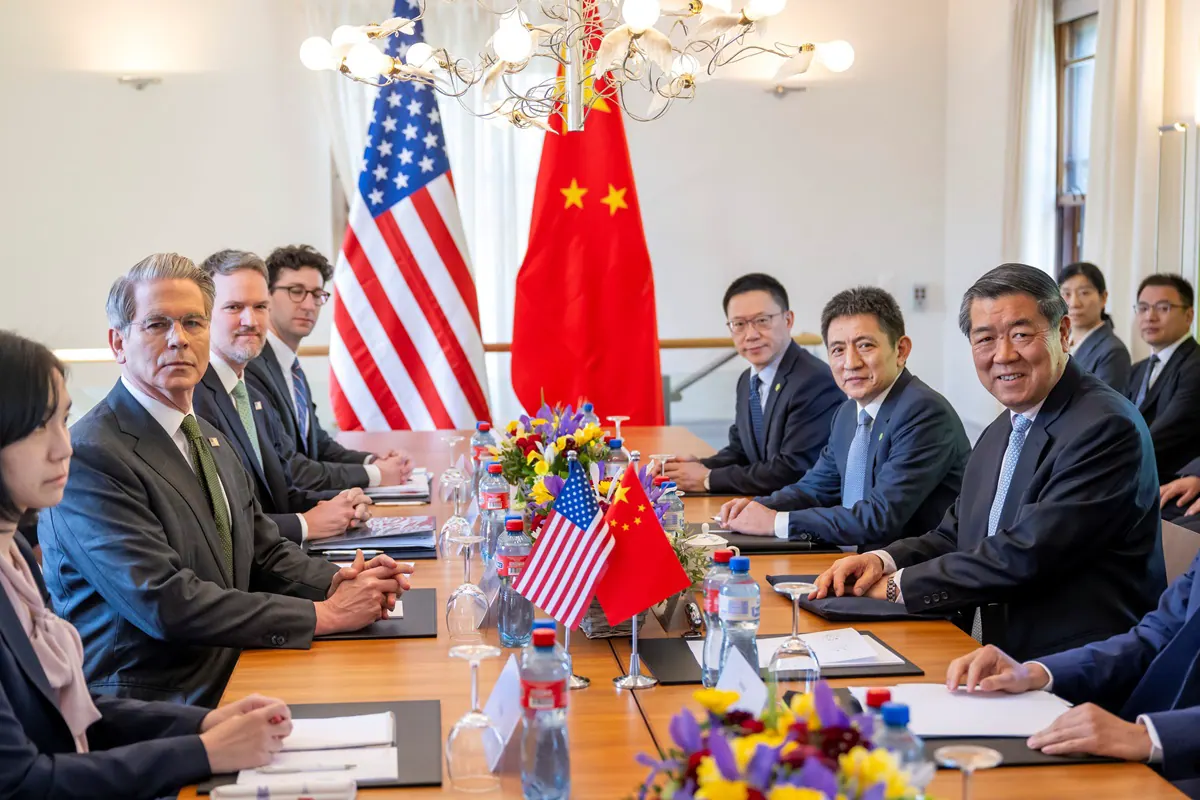
Top economic envoys from Washington and Beijing have established a formal crisis channel for artificial intelligence during an eight-hour marathon session at JPMorgan Chase’s New York headquarters. This initiative, labelled the U.S.-China AI Dialogue, represents a proactive effort to build operational guardrails around advanced technology before national security triggers spiral out of control. U.S. Treasury Secretary Scott Bessent and Chinese Vice Premier He Lifeng led the bilateral talks, setting the stage for an upcoming White House summit between President Donald Trump and President Xi Jinping.
The mechanism acts like a Cold War hotline for reporting severe AI failures and national security incidents. Negotiators focused primarily on creating an emergency notification mechanism designed to function much like a Cold War hotline. Under this framework, both superpowers must notify one another if an artificial intelligence system experiences a severe failure, triggers a national security incident, or faces exploitation by rogue actors. Treasury Secretary Scott Bessent outlined the plan to reporters following the session, confirming that Washington proposed a direct notification pathway for incidents that reach a national security threshold.
Washington remains focused on extreme frontier risks and unexpected autonomous system behaviours, while Beijing prioritises infrastructure stability and cyber defence. Despite these different internal priorities, both nations recognise that unmanaged autonomous failures create mutual geopolitical hazards that require direct communication. The U.S. and China have different approaches to AI, but they agree on the need for a crisis hotline to prevent accidental escalation.
Discussions extended into technical architecture, specifically contrasting open-weight and closed-weight systems. Chinese open-weight models continue to capture global market share through low operational costs, raising security concerns among American officials regarding system control and software bifurcation. Delegates also worked to secure supply chains for critical minerals, focusing on rare earth magnets required for data centre hardware and server infrastructure ahead of an expiring trade truce.
U.S. Trade Representative Jamieson Greer stressed that both nations must maintain clear channels despite fierce economic competition. The talks also covered technical risks surrounding open-weight software and critical mineral supply chains. A finalised agreement on this notification channel will determine whether both powers can separate baseline technological safety from broader economic rivalries.
Establishing a working crisis hotline would mark a decisive step toward preventing accidental escalation as artificial intelligence capabilities expand worldwide. The New York negotiations structure a clear binary decision for President Trump before he meets President Xi at the White House. Both nations are working to find common ground on AI, despite their differences.
The U.S.-China AI Dialogue is a significant development in the relationship between the two superpowers, as they seek to mitigate the risks associated with AI. The initiative is a proactive effort to build operational guardrails around advanced technology, and it sets the stage for further cooperation on AI between the U.S. and China.
Key points
- The U.S. and China have proposed a formal crisis channel for artificial intelligence, labelled the U.S.-China AI Dialogue.
- The mechanism acts like a Cold War hotline for reporting severe AI failures and national security incidents.
- Establishing a working crisis hotline would mark a decisive step toward preventing accidental escalation as artificial intelligence capabilities expand worldwide.