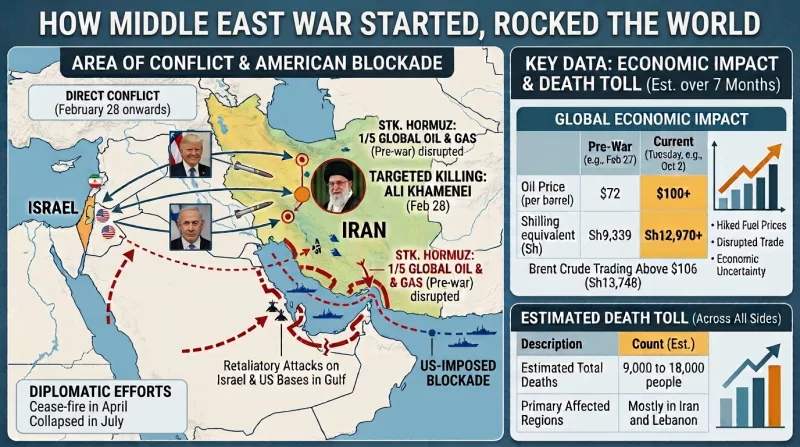
The war in the Middle East, which began on February 28, has resulted in between 9,000 and 18,000 deaths across all sides, mostly in Iran and Lebanon. The conflict escalated from decades of tension and proxy wars into direct conflict when US President Donald Trump and Israeli Prime Minister Benjamin Netanyahu launched attacks on Iran, killing its Supreme Leader Ali Khamenei. Iran and its allies retaliated with attacks on Israel and US military bases in the Gulf, as well as on shipping through the Strait of Hormuz.
The conflict has had significant economic impacts globally, with oil prices standing above $100 a barrel, with Brent crude trading above $106. The price was $72 before the war. A temporary cease-fire in April faltered and eventually collapsed in July, leading to a blockade on Iranian ports by the US. The impasse has hiked fuel prices, disrupted trade, and raised economic uncertainty worldwide. Kenya, as an importing nation, faces immediate transport, production, and household cost pressures.
Dr Ali Gholampour, Iran's Ambassador to Kenya, attributes the conflict to Israel's expansionist policy and Iran's right to maintain a peaceful nuclear programme. He accused Israel of an expansionist policy aimed at maintaining Middle Eastern dominance alongside the United States. Gholampour emphasized that Iran has always stood by the oppressed people of Palestine and highlighted decades of Palestinian occupation, describing Gaza as "the largest open prison in the world".
On the other hand, Eylon Levy, former spokesperson to Israeli Prime Minister Benjamin Netanyahu, sees the confrontation through national security and deterrence. He believes that economic pressure will force Iran to surrender first and backs President Donald Trump's belief that economic pressure has placed Tehran's leadership under severe strain. Levy proposed a solution based on the "three Ds": disarmament of Hamas, demilitarisation of Gaza, and deradicalisation of Palestinian society.
The disagreement between Gholampour and Levy extends to the Israeli-Palestinian conflict. Gholampour argued that international law prohibits destroying an entire society or targeting civilians, while Levy framed the issue around Israel's right to defend its citizens. The two envoys have contrasting views on the root of the conflict, with Gholampour pointing to Israeli military aggression and Levy highlighting Iran's nuclear and ballistic missile programmes.
The global stakes of the conflict become acute in the Strait of Hormuz, an economic artery carrying massive volumes of oil. Disruption spikes shipping, energy, and insurance costs worldwide. Gholampour said Iran historically allowed commercial shipping but restricted access after military operations were launched against it through the Gulf. Levy countered that Iran uses the strait for asymmetric warfare because it cannot defeat US and Israeli forces conventionally.
The conflict has significant implications for Kenya and the region. Gholampour and Levy appealed to different perspectives on self-defence, with Gholampour maintaining Iran's military responses were legitimate self-defence and Levy arguing Israel responded to Iran's missile attacks, nuclear ambitions, and its regional "ring of fire". The conflict highlights the need for a peaceful resolution to avoid further economic and humanitarian crises.
Key points
- The conflict has resulted in significant economic impacts globally, with oil prices standing above $100 a barrel.
- The disagreement between Iran and Israel extends to the Israeli-Palestinian conflict, with contrasting views on the root of the conflict.
- The global stakes of the conflict become acute in the Strait of Hormuz, an economic artery carrying massive volumes of oil.