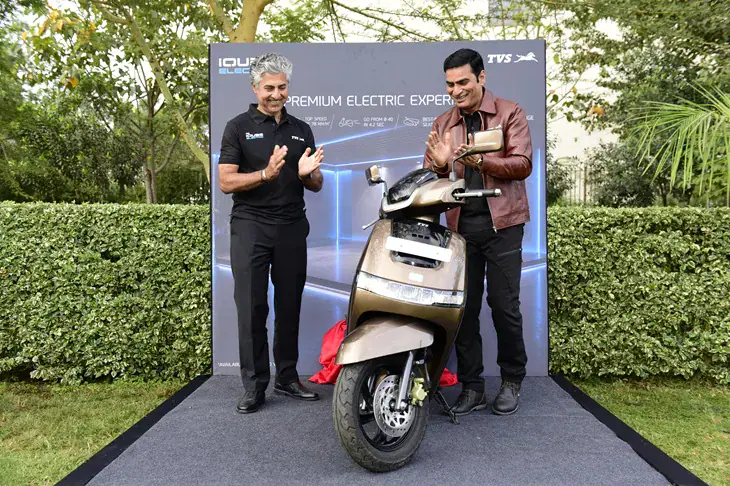
TVS Motor Company, the world's third-largest two-wheeler maker, has launched its iQube electric scooter in Kenya, marking the first African market for the model. The iQube will be sold through Car & General's nationwide dealer network. The company aims to capitalize on growing consumer demand, supportive policy, and rising environmental awareness in Kenya. The iQube is offered in two variants with different ranges.
The iQube electric scooter comes in two variants, one with a claimed range of up to 75 km per charge and another reaching 115 km. Both variants can be recharged from a standard household socket without a dedicated wall box. This feature is expected to make it convenient for users to charge their scooters at home. The iQube's appeal is targeted at salaried commuters who travel the same route daily.
According to TVS Kenya's associate vice-president Pradeep Chaurasiya, the launch of the iQube in Kenya is a "natural extension" of the company's African expansion. Car & General CEO Vijay Gidoomal cited favourable conditions for electric two-wheelers, including growing consumer demand, supportive policy, and rising environmental awareness. The company believes that the iQube will be well-received in the Kenyan market.
The iQube's marketing material cites an estimated KES 47,000 annual saving in running costs compared with a petrol-powered scooter. This breaks down to roughly KES 3,900 per month, KES 900 per week, or KES 130 per day. The savings calculation is based on lower electricity costs from Kenya Power and reduced maintenance needs, as electric motors have fewer moving parts than internal-combustion engines.
Despite the potential benefits, practical adoption of the iQube will depend on several factors, including the upfront price, which was not disclosed at the launch announcement. The availability of secure parking with a private electricity meter for overnight charging is also crucial. Additionally, the higher purchase price of electric two-wheelers relative to petrol equivalents and the need for flexible financing options may affect adoption.
Other hurdles identified for the iQube's adoption include occasional power outages and safety concerns linked to the quiet operation of scooters on busy Kenyan roads. The company will need to address these challenges to ensure the iQube's success in the Kenyan market. The launch of the iQube is seen as a significant step in TVS Motor Company's African expansion.
The iQube's launch in Kenya marks a new milestone for TVS Motor Company in Africa. The company's entry into the Kenyan market is expected to contribute to the growth of the electric two-wheeler industry in the region. As the first African market for the iQube, Kenya will play a crucial role in shaping the model's success in the continent.
Key points
- TVS Motor Company launches iQube electric scooter in Kenya, promising up to KES 47,000 annual savings for users.
- The iQube is offered in two variants with claimed ranges of up to 75 km and 115 km per charge.
- The launch faces challenges around price, charging infrastructure, and financing.