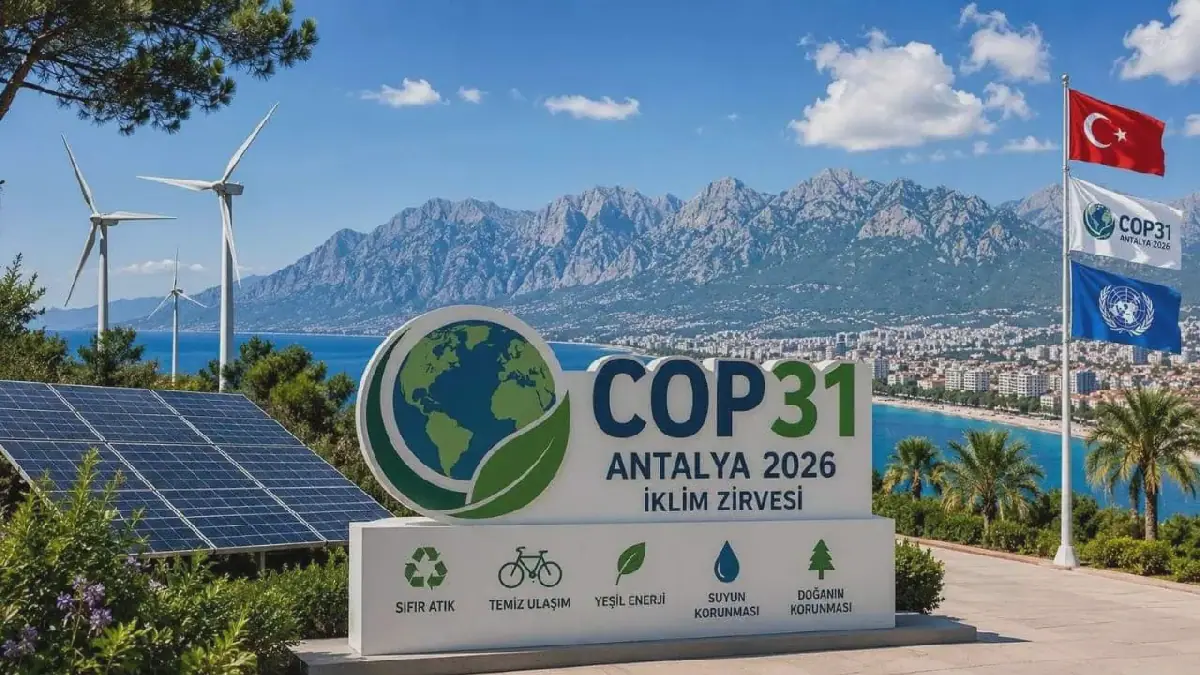
The 31st United Nations Climate Conference, or COP31, will take place in Antalya, Turkey, from November 9 to 20, 2026. This event marks a significant milestone as Turkey assumes the presidency of the COP for the first time. Turkish President Recep Tayyip Erdogan's administration aims to make this conference a turning point in climate diplomacy by shifting the focus from commitments to concrete results. The Turkish government plans to promote a model that combines international cooperation, energy security, industrial innovation, and a circular economy.
Turkey's approach to COP31 is built around three core principles: dialogue, consensus, and action. The country seeks to translate climate commitments into tangible actions, particularly in reducing emissions, adapting to climate change, and securing climate finance. Turkey's transformation in the energy sector will be a key aspect of its presentation, showcasing progress in renewable energy, industrial development, and infrastructure. This approach is underpinned by two complementary pillars: intergovernmental negotiations and a comprehensive Action Program.
The Action Program for COP31 is a critical component of Turkey's strategy. It encompasses various areas, including the energy transition, circular economy, resilient cities, green industrialization, climate finance, food security, and ocean protection. The program sets specific targets for 2035, such as increasing the share of electricity in global final energy consumption to 35%, reducing municipal waste growth by half, and decreasing the energy intensity of buildings by at least 25%. This program is designed as a voluntary cooperation platform, aiming to accelerate the implementation of existing commitments through partnerships and large-scale projects.
Turkey's energy sector has undergone significant developments, with a focus on renewable energy sources. As of September 2026, the country's installed power capacity reached 127.3 GW, with approximately 63% coming from renewables. The Turkish government aims to increase this capacity to 281 GW by 2040, with solar and wind energy accounting for 175 GW of the total. Nuclear energy is also part of Turkey's strategy, with plans to develop 10 GW of nuclear capacity by 2040 through projects like Akkuyu, Sinop, and Thrace.
Turkey's energy market has undergone substantial modernization over the past 25 years. The country has reformed its electricity and natural gas markets to promote competition, transparency, and efficiency. The Energy Exchange Istanbul (EPİAŞ), established in 2015, plays a central role in this process, managing organized electricity and natural gas markets. EPİAŞ facilitates transparent price formation, secures transactions, and integrates renewable energy sources. The company is also preparing for the development of emission trading mechanisms and carbon markets to support the decarbonization of the economy.
Turkey's transportation sector, particularly maritime, is also undergoing a transformation. The Turkish government aims to showcase its industrial expertise and technological capabilities in this area. The country has made significant strides in developing electric and hybrid vessels, such as the GİSAŞ POWER, a fully electric tugboat designed and built by Turkish engineers. This innovation highlights Turkey's potential in reducing the environmental impact of port operations while maintaining competitiveness.
The Turkish presidency of COP31 is built on a unique partnership with Australia, which will direct formal negotiations in coordination with Turkey. This cooperation brings together Turkey's strategic position at the crossroads of Europe, Asia, and the Middle East with Australia's expertise and representation of Pacific island concerns. The two countries have engaged in extensive international consultations throughout 2026 to align the positions of developed and developing countries.
Key points
- Turkey aims to make climate transition a driver of its economic transformation at COP31.
- The country plans to focus on implementing climate commitments and promoting a new economic model that combines international cooperation, energy security, industrial innovation, and a circular economy.
- Turkey has set specific targets for 2035, including increasing the share of electricity in global final energy consumption to 35% and reducing municipal waste growth by half.