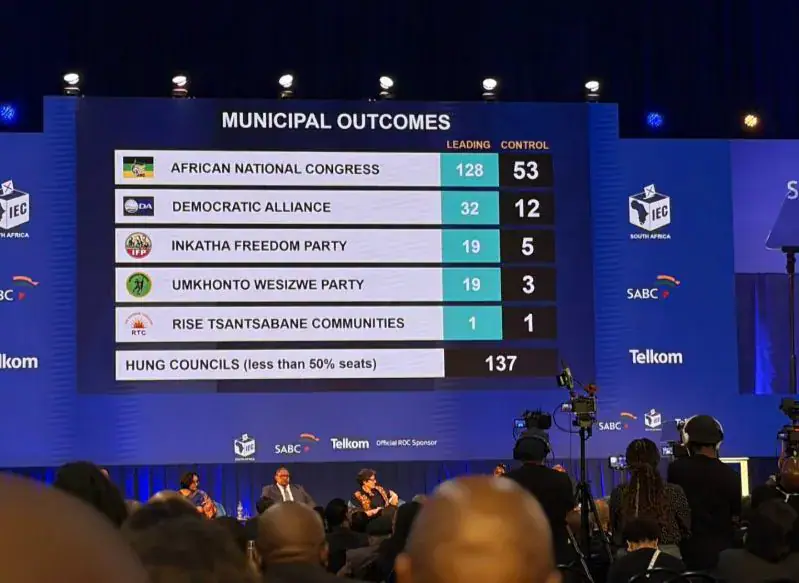
South Africa's newly elected municipal councils are set to hold their first meetings within 14 days, marking the beginning of coalition negotiations to determine local leadership. The Electoral Commission of South Africa announced the final results on Sunday night, concluding the voting and counting process. The outcome of these negotiations will determine who takes responsibility for municipal finances, infrastructure, and essential services over the next five years.
Under Section 29(2) of the Local Government: Municipal Structures Act, municipal managers are required to convene these meetings within the 14-day deadline. At these meetings, councillors will elect their speakers and mayors, with the outcome depending on which parties can secure enough support in council. The 14-day deadline does not mean parties are legally required to have signed coalition agreements by then, but they will need to negotiate and establish sufficient support to ensure councils can elect their leadership.
Cooperative Governance and Traditional Affairs Minister Velenkosini Hlabisa said coalition discussions were expected to begin on Wednesday. He will convene a special meeting with provincial MECs responsible for local government to discuss the process, stressing the need for stable municipal administrations and uninterrupted service delivery. This meeting aims to ensure a smooth transition and effective governance at the local level.
Nationally, the ANC emerged as the largest party with 30.77% of the vote and 3,236 council seats, followed by the Democratic Alliance with 24.64% and 1,638 seats. The MK Party secured 9.77% and 765 seats, the EFF received 6.22% and 562 seats, while ActionSA obtained 5.67% and 270 seats. These numbers indicate that coalition negotiations will be crucial in determining who will govern in various municipalities.
Despite emerging as the largest party, the ANC did not secure outright majorities across most municipalities, leaving coalition negotiations crucial to determining who will govern. The IEC chairperson, Mosotho Moepya, confirmed that all 213 municipal councils had been finalised and declared. This paves the way for parties to engage in coalition talks and determine the leadership of each municipality.
Voter turnout stood at 52%, compared with 45.9% in the 2021 local government elections. The increased turnout indicates a higher level of engagement from South African citizens in the electoral process. As coalition negotiations begin, residents will be watching closely to see how the outcome affects municipal finances, infrastructure, and essential services in their areas.
The negotiations will likely be complex, with multiple parties involved and various interests at stake. The outcome will have a significant impact on the daily lives of South Africans, as municipal councils are responsible for delivering essential services such as water, sanitation, and electricity. As the process unfolds, citizens will be eager to see how the new leadership will address their needs and priorities.
Key points
- The ANC emerged as the largest party with 30.77% of the vote and 3,236 council seats.
- Coalition negotiations will be crucial in determining who will govern in various municipalities.
- Municipal councils must hold their first meetings within 14 days to elect mayors and speakers.