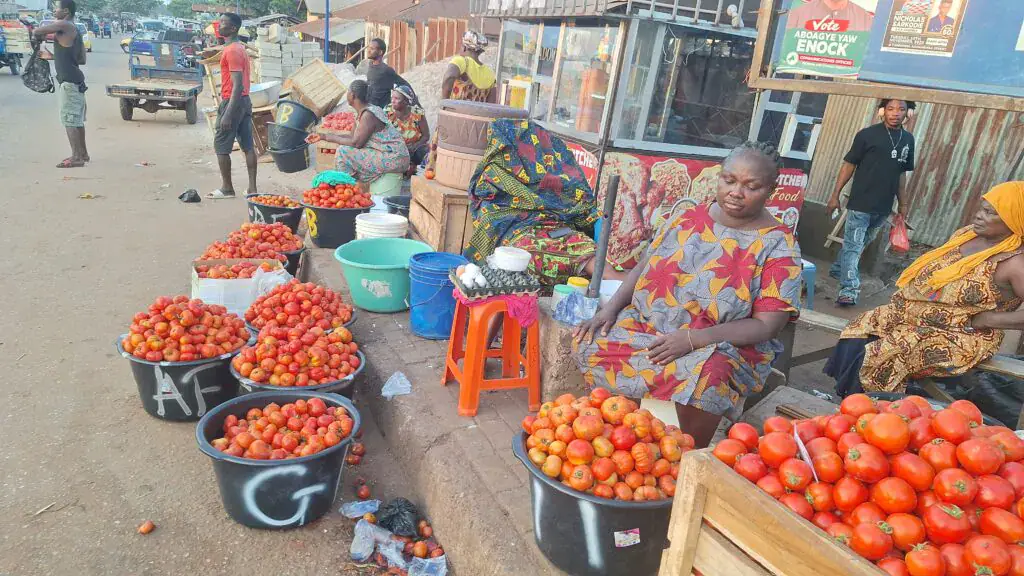
Tuobodom, a farming community in Ghana's Bono East Region, is bracing for another anxious harvest season. Months of hard work and perseverance against erratic rainfall, high input costs, pests, and diseases have finally yielded a bountiful harvest. However, the real challenge now is finding a ready market for the tomatoes. The sight of fields heavy with fruit, which should bring joy and prosperity, instead fills many families with anxiety and frustration.
The harvesting season has become a source of worry for Tuobodom farmers due to the dwindling presence of bulk buyers. Trucks that once arrived regularly to purchase tomatoes in large quantities no longer come as frequently as they used to. When buyers do arrive, traders often dictate prices, even after agreeing on a price per box before harvesting. This leaves farmers with little bargaining power, forcing them to accept whatever is offered or risk losing their entire harvest.
The current market prices for tomatoes vary significantly depending on the variety. A box of the improved variety, known as peto, sells for between GH¢1,500 and GH¢1,700, while a box of the local variety, called power, sells for between GH¢300 and GH¢500. This substantial gap explains why farmers are eager to shift away from the local variety, despite being trapped in producing it due to financial constraints. The improved variety is preferred by traders and consumers for its longer shelf life, better taste, and ease of transportation.
However, the high cost of seeds for the improved variety is a major obstacle for many farmers. One tin of the improved seed costs GH¢1,300, which is unaffordable for most farmers already struggling with the costs of fertilizer, chemicals, and labor. As a result, many farmers are forced to plant the local variety, which, although cheaper, yields lower income due to its poor quality and limited market demand.
Farmers like George Ayiti express frustration at the unfair treatment they receive from traders during harvest time. According to Ayiti, traders often agree on a price per box before harvesting, only to change it when they arrive on the farm. "We agree on a price before we harvest, but when the buyers come, they change the price," he said. "We have no choice because if we refuse, the tomatoes will rot on the farm. So we accept whatever they give us."
The challenges faced by Tuobodom farmers are further exacerbated by unpredictable weather patterns. Emmanuel Ankomah notes that erratic rainfall this season has affected planting, growth, and harvesting, resulting in significant losses for many farmers. "We cannot continue to look up to the sky for farming. The rain does not come when we need it, and when it comes, it is too much," he said. Ankomah believes that irrigation systems would help farmers achieve a steady income and reduce the pressure of the glut season.
The struggles of Tuobodom's tomato farmers highlight the need for sustainable solutions to address the challenges they face. With the support of stakeholders, including government agencies and private investors, farmers hope to adopt modern farming practices, such as irrigation, and improve their bargaining power in the market. This would enable them to secure a fair price for their produce and improve their livelihoods.
Key points
- Erratic rainfall and high input costs have affected tomato production in Tuobodom, Ghana.
- Farmers struggle to secure a fair market for their produce due to limited bargaining power.
- Irrigation systems could help farmers achieve a steady income and reduce the pressure of the glut season.