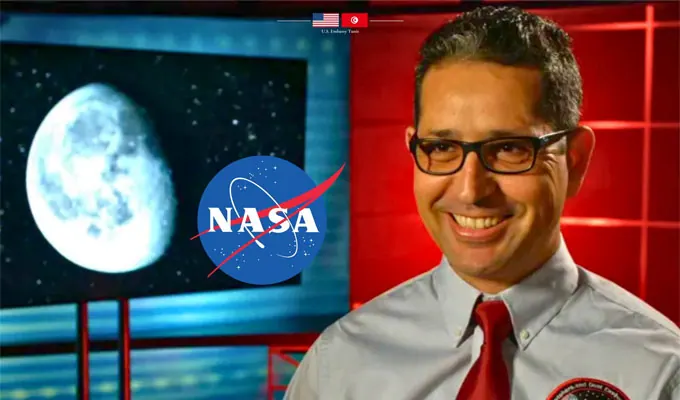
The United States Embassy in Tunisia recently highlighted Mehdi Benna, a Tunisian scientist, as the lead researcher on the Lunar Environment Monitoring Station (LEMS) project. LEMS is an instrument developed by NASA's Goddard Space Flight Center to measure seismic activity near the Moon's south pole. Benna's work on LEMS is a significant milestone in his career, which began in Tunisia and continued in France and at NASA's Goddard Space Flight Center.
Mehdi Benna's journey to leading the LEMS project began with his education in Tunisia. He earned a degree in electrical engineering from the École nationale d'ingénieurs de Tunis (ENIT) in 1999 and a master's degree in radio telecommunications from the University of Tunis in 2000. Benna then pursued his Ph.D. in space sciences at the University of Toulouse in France, which he completed in 2002.
After completing his education, Benna joined the Goddard Space Flight Center as a postdoctoral researcher in 2003. His work has focused on planetary sciences, including plasma physics, magnetospheres, and planetary exospheres. Benna has contributed to the development of several instruments for space missions, including those around Mars and the Moon. He is now the Principal Investigator of the LEMS project.
The LEMS instrument is designed to be compact, autonomous, and capable of long-duration observations in the lunar south pole region. Its primary mission is to record ground movements caused by lunar seismic activity, which will help scientists better understand the Moon's crust and mantle structure. This information will provide valuable insights into the Moon's formation and evolution.
NASA announced the selection of LEMS for further development in March 2024, along with two other instruments, under the Artemis program. The agency completed the development and testing of LEMS in 2026, subjecting it to various tests, including simulations of launch vibrations and lunar environmental conditions. The instrument is designed to operate for up to two years, with a high degree of autonomy and minimal human intervention.
Mehdi Benna's achievement is also a source of pride for Tunisia, as it highlights the country's contribution to international scientific endeavors. The LEMS project demonstrates the potential for collaboration and knowledge sharing between countries and institutions. Benna's story serves as an inspiration to young scientists and engineers in Tunisia and around the world.
The LEMS project is a significant step forward in lunar exploration, and Mehdi Benna's leadership has been instrumental in its development. As the project moves forward, it is expected to provide valuable scientific data and insights into the Moon's internal structure. The success of LEMS will also pave the way for future lunar missions and contribute to a deeper understanding of the Moon's role in the solar system.
Key points
- Mehdi Benna, a Tunisian scientist, is leading the NASA LEMS project to measure seismic activity near the Moon's south pole.
- LEMS is designed to operate for up to two years, with a high degree of autonomy and minimal human intervention.
- The project demonstrates the potential for collaboration and knowledge sharing between countries and institutions.