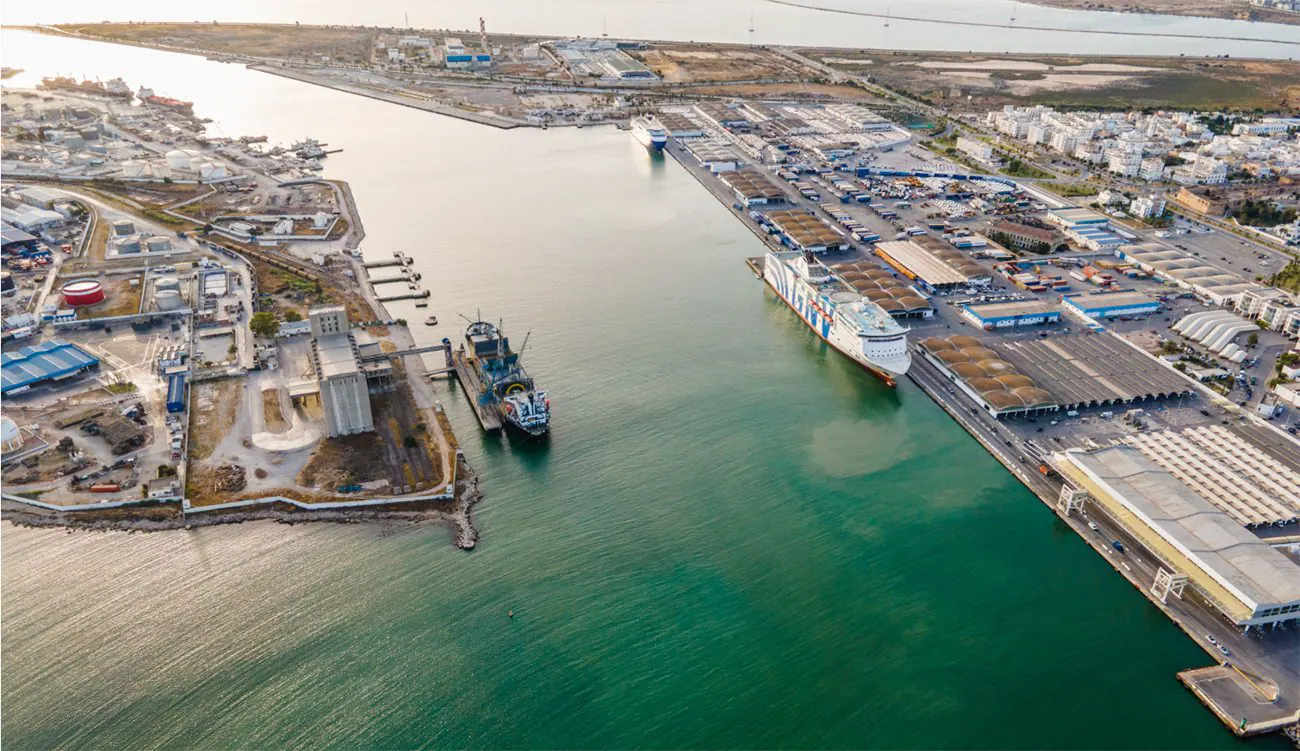
The Tunisian maritime sector has demonstrated resilience and dynamism in 2025, despite an international economic context marked by challenges. According to the Office de la marine marchande et des ports (OMMP), the country's ports handled a total of 27.1 million tonnes of goods, a 3% decrease compared to 27.8 million tonnes in 2024. This stability is a testament to the solidity of the OMMP's organization and the relevance of its strategic choices.
The European Union remains the main partner for Tunisia's trade, accounting for 61% of the total goods exchanged. In 2025, the EU-Tunisia trade reached 16.4 million tonnes, with 59% of goods imported and 65% exported. The main products traded with the EU are hydrocarbons, sulfur, cereals, and other miscellaneous goods. The OMMP's report highlights that the port of Radès is the country's leading commercial hub, with the highest volume of traffic.
The trade with other regions, including the Maghreb arabe, Africa, the Americas, and Asia, also shows significant figures. The Maghreb arabe countries, mainly Morocco, Algeria, and Libya, accounted for 5% of the total goods exchanged, while other African countries, excluding the Maghreb arabe, handled 578,000 tonnes, representing 2% of the total trade. Egypt is the main country of origin and destination for these trades.
The port of Radès dominates the country's commercial activity, but other ports, such as Bizerte, Gabès, and Sfax, also play a significant role. The OMMP's report notes that the traffic of hydrocarbons decreased by 7% in 2025, while the traffic of crude oil decreased by 23%. However, the unloading of refined products increased by 9%, reaching 4.5 million tonnes.
In 2025, the number of ships that docked at Tunisian commercial ports reached 4,026, a 1% decrease compared to 2024. The OMMP obtained the international ISO 9001 version 2015 certification in July 2025, marking a significant milestone in its 60-year history. This certification demonstrates the office's commitment to quality and customer satisfaction.
The tourism sector also shows signs of recovery, with 272,475 cruise passengers in 2025, indicating a renewed attractiveness of Tunisia as a tourist destination. The port of La Goulette is the main hub for passenger and vehicle traffic, while the port of Zarzis handles the rest of the traffic, particularly for the southern region of Tunisia.
The OMMP's report highlights that the balance of trade remains deficitary in volume, with 17.6 million tonnes of imports and 9.4 million tonnes of exports. However, the office is working to improve the competitiveness of Tunisian ports and enhance the country's maritime sector. The OMMP's efforts aim to make Tunisian ports more efficient and attractive to international trade.
Key points
- - European Union is the main trading partner for Tunisia, accounting for 61% of total goods exchanged. - Tunisian ports handled 27.1 million tonnes of goods in 2025, a 3% decrease from 2024. - OMMP obtained the international ISO 9001 version 2015 certification in July 2025.