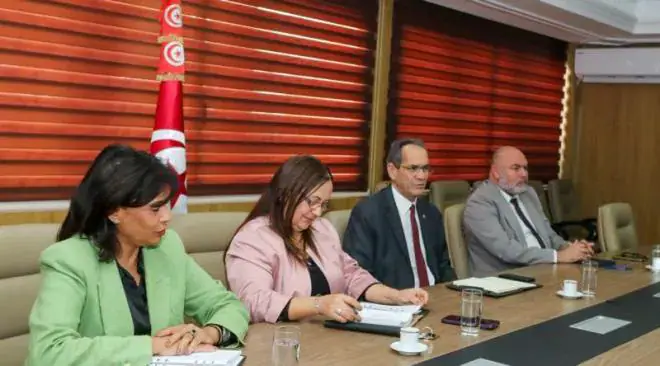
On November 19, 2026, Mondher Belaid, the Minister of Higher Education and Scientific Research in Tunisia, hosted a delegation from the World Bank, led by Fadhila Caillaud, Director of Education for the Middle East and North Africa region. The meeting, which took place at the Ministry's headquarters, aimed to explore avenues for collaboration between the Tunisian government and the World Bank to support the country's education and employment sectors.
The World Bank delegation included Himdat Bayusuf, a senior education specialist for the Middle East and North Africa region, as well as other experts in education and economics. The Tunisian side was represented by Malik Kchalf, Director General of International Cooperation, and other officials from the Ministry. The meeting focused on reviewing progress made in implementing the first component of the Education Sector Support Project (PASE), which aims to enhance coordination and governance between sectors involved in education and employment.
The PASE project is a key initiative that seeks to improve the quality of education and training in Tunisia, with a focus on promoting employability and entrepreneurship. Minister Belaid emphasized the strategic importance of this project, particularly in terms of coordinating programs and activities between different structures and ministries involved in education and employment. He called for the establishment of an information system that would enable the exchange of information between these entities.
The meeting between Minister Belaid and the World Bank delegation reflects the ongoing efforts of the Tunisian government to strengthen partnerships with international organizations and development partners. The World Bank has been a key partner for Tunisia in supporting reforms and projects in various sectors, including education and employment. The two sides discussed ways to enhance cooperation and mobilize resources to support Tunisia's development priorities.
One of the key objectives of the PASE project is to improve the employability of Tunisian graduates by enhancing the quality of education and training. The project also aims to promote entrepreneurship and self-employment, particularly among young people. The World Bank has provided significant financial support to Tunisia in recent years, with a focus on supporting reforms and projects in key sectors such as education, healthcare, and infrastructure.
The meeting between Minister Belaid and the World Bank delegation is a positive step towards strengthening cooperation between Tunisia and the World Bank. The two sides are expected to continue their discussions in the coming weeks and months, with a view to finalizing agreements and launching new projects to support Tunisia's development priorities. The World Bank has reaffirmed its commitment to supporting Tunisia's efforts to promote economic growth, reduce poverty, and improve living standards.
The Tunisian government has made significant progress in recent years in implementing reforms and projects aimed at promoting economic growth and reducing poverty. The country has also made notable strides in improving its education and healthcare systems, with support from international partners such as the World Bank. The meeting between Minister Belaid and the World Bank delegation is a testament to the strong partnership between Tunisia and the World Bank.
Key points
- The meeting between Minister Belaid and the World Bank delegation aimed to enhance cooperation and mobilize resources to support Tunisia's education and employment sectors.