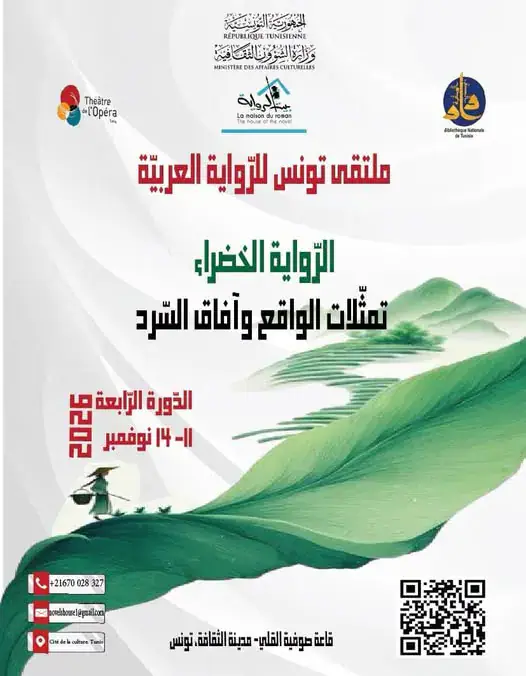
The fourth edition of the Tunisian Narrative Meeting, titled "Green Narrative: Representations of Reality and Narrative Horizons," recently commenced in Tunisia. The event features a session on the green narrative in Arabic literature, focusing on its concept and narrative transformations. Participants discussed the significance of resistance narratives in Arabic literature about nature and climate change in the region.
The session highlighted the emergence of a new critical trend known as "ecocriticism" or "green studies," which aims to create a comprehensive cultural shift in human relationships with the environment. This trend, first introduced in 1978 by William Rueckert, seeks to alert literature to the risks of pollution and environmental degradation.
Speakers at the meeting emphasized the importance of personal narratives in discussing nature, moving from reality to imagination. They noted that literature can create broader worlds that transcend time and space, making nature the center of every story. Algerian novelist and academic Haj Ahmed Al-Ziywani presented a paper titled "Narratives of the Desert... Design of Drought," which explored the concept of desert narratives in Algerian literature.
Al-Ziywani argued that the desert has been stereotypically associated with images of nomadism and instability in Arabic literature. However, new narratives have redefined the desert as a place of life and meaning. He highlighted the diversity of natural manifestations in the desert, citing the oasis as a symbol of the green desert in Algerian literature.
Mauritanian academic Makfoula Bent Akkat presented a paper on the green narrative and its concepts, arguing that it is not possible to categorize issues related to climate change and the environment in literature. She emphasized that any literary work can be read from an environmental perspective without being classified as a separate literary genre.
Yemeni writer and researcher Majeeb Al-Rahman Al-Wasabi discussed the significance of the "qat" tree in Yemeni culture and its role in shaping identity and memory. He argued that environmental criticism, or ecocriticism, goes beyond simply examining the presence of nature in literature to explore the relationship between humans and the world around them.
The meeting continues with literary sessions and parallel activities until November 14, 2026. Participants emphasized the importance of encouraging writers to address environmental issues through literature, particularly in the current context. They called for the establishment of competitions and prizes to support writers who engage with these topics, also known as "green narrative."
Key points
- The Tunisian Narrative Meeting explores the concept of green narrative in Arabic literature and its role in addressing environmental issues.