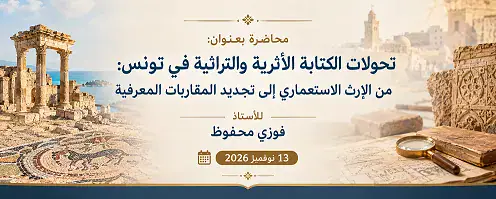
On November 13, 2026, Professor Fawzi Mahfouz delivered a lecture titled "Transformations in Archaeological and Heritage Writing in Tunisia: From Colonial Legacy to Renewed Cognitive Approaches." The lecture, broadcast on Radio Tunisie Culture, explored the evolution of archaeological and heritage writing in Tunisia from the late 19th century to the present day. It examined the development of research methodologies and their challenges, as well as their connections to political, institutional, and intellectual contexts that shaped them.
The lecture highlighted how modern archaeological studies emerged in Tunisia during the colonial period, influenced by an ideological discourse that glorified the classical Roman heritage while marginalizing later historical periods, particularly the Islamic era. This approach contributed to a reductionist view of North African history, which was later revised through scientific contributions that recognized the role of local communities and socioeconomic transformations.
The development of the Tunisian school of archaeological and heritage studies after independence was also discussed. The lecture noted the persistence of certain inherited scientific traditions, the emergence of new research trends, and an increased focus on Islamic and urban heritage. The evolution of university research enabled a shift from descriptive and classificatory approaches to more specialized and comprehensive studies, combining written sources, archaeological evidence, and historical and geographical analysis.
The lecture also addressed contemporary transformations in the field, including the use of digital technologies, geographic information systems, and databases. It noted the expansion of the concept of heritage to include intangible cultural heritage, previously marginalized areas, and multiple memories. The challenges related to scientific production, publication, documentation, and valorization were also examined, as well as the extent to which heritage policies have kept pace with academic research developments.
Professor Mahfouz's lecture emphasized that the history of archaeological and heritage writing in Tunisia cannot be reduced to a series of decisive epistemological breaks. Instead, it reflects a complex process where continuity and renewal intersect. This understanding calls for the development of critical, multidisciplinary approaches that link archaeological research to social and cultural history, connecting knowledge production to heritage protection and valorization issues.
The lecture comes amid a vibrant cultural scene in Tunisia, with various literary events taking place. For example, the Tunis International Arabic Novel Meeting will host 18 countries under the theme "The Green Novel: Representations of Reality and Narrative Horizons." Additionally, five Tunisian publishing houses will participate in the 45th Sharjah International Book Fair, featuring writer Nizar Shaqroun.
The cultural events and lecture demonstrate Tunisia's ongoing efforts to promote its literary and archaeological heritage. By exploring the evolution of archaeological and heritage writing, Professor Mahfouz's lecture contributes to a deeper understanding of the complex relationships between knowledge production, cultural heritage, and historical narratives in Tunisia.
Key points
- The lecture series is part of a broader effort to promote cultural and intellectual exchange in Tunisia.