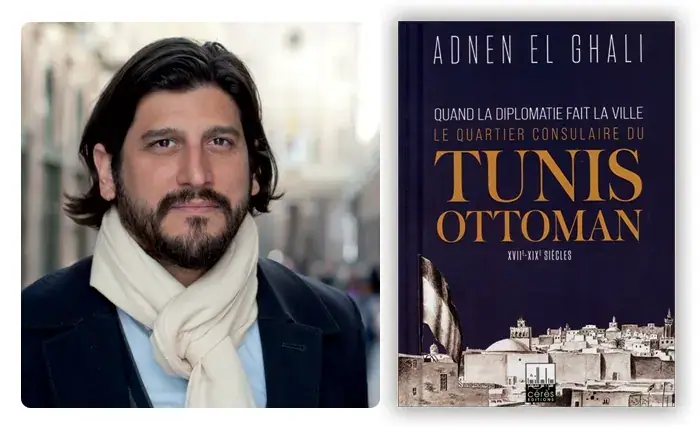
Historian Adnen El Ghali has published a book titled "Quand la diplomatie fait la ville. Le quartier consulaire du Tunis ottoman, XVIIe-XIXe siècles" (When Diplomacy Shapes the City: The Consular Quarter of Ottoman Tunis, 17th-19th centuries). The book is based on his doctoral thesis, which he defended at the Université libre de Bruxelles in 2021. El Ghali's work explores the role of consular representations in shaping the urban landscape of Tunis during the Ottoman era.
El Ghali's research focuses on the medina of Tunis, where fondouks, consular houses, and places of worship structured the urban space and reflected the influence of various powers. The author, an architect, urbanist, and historian, offers a multidisciplinary analysis of the consular quarter. His book sheds light on the intense competition among European powers during this period and how it was reflected in the architecture and urban planning of the city.
The book is published by Cérès Editions and provides a detailed examination of the consular quarter's development during the 17th to 19th centuries. El Ghali's work is considered a significant contribution to the field of urban history and the study of Ottoman-era Tunis. The author's analysis highlights the complex relationships between diplomacy, architecture, and urban planning in shaping the city's landscape.
Tunis was a highly active capital during the Ottoman era, with various European powers establishing consular representations in the city. These representations not only served diplomatic purposes but also played a significant role in shaping the urban space. El Ghali's book explores how these consular representations influenced the development of the city's architecture, infrastructure, and social fabric.
The author's research is based on extensive archival research and fieldwork, providing a rich and nuanced understanding of the consular quarter's history. El Ghali's work has been praised for its interdisciplinary approach, combining insights from history, architecture, and urban planning. The book is considered a valuable resource for scholars and researchers interested in the history of Tunis, Ottoman-era diplomacy, and urban studies.
El Ghali's book has been well-received by the academic community, with many praising its originality and depth. The author's work has also been recognized for its contribution to the field of Tunisian studies, providing new insights into the country's rich history and cultural heritage. The book is available at Cérès Editions and has sparked interest among scholars and researchers in the field.
The publication of El Ghali's book coincides with a renewed interest in the history and cultural heritage of Tunis. The city's medina, with its rich architectural and cultural heritage, continues to be a subject of study and fascination for scholars and tourists alike. El Ghali's work provides a valuable contribution to this field, shedding new light on the complex history of the consular quarter and its significance in the context of Ottoman-era Tunis.
Key points
- Adnen El Ghali's book explores the role of European consular representations in shaping the urban landscape of Tunis during the Ottoman era.
- The book provides a multidisciplinary analysis of the consular quarter, combining insights from history, architecture, and urban planning.
- El Ghali's research is based on extensive archival research and fieldwork, providing a rich and nuanced understanding of the consular quarter's history.