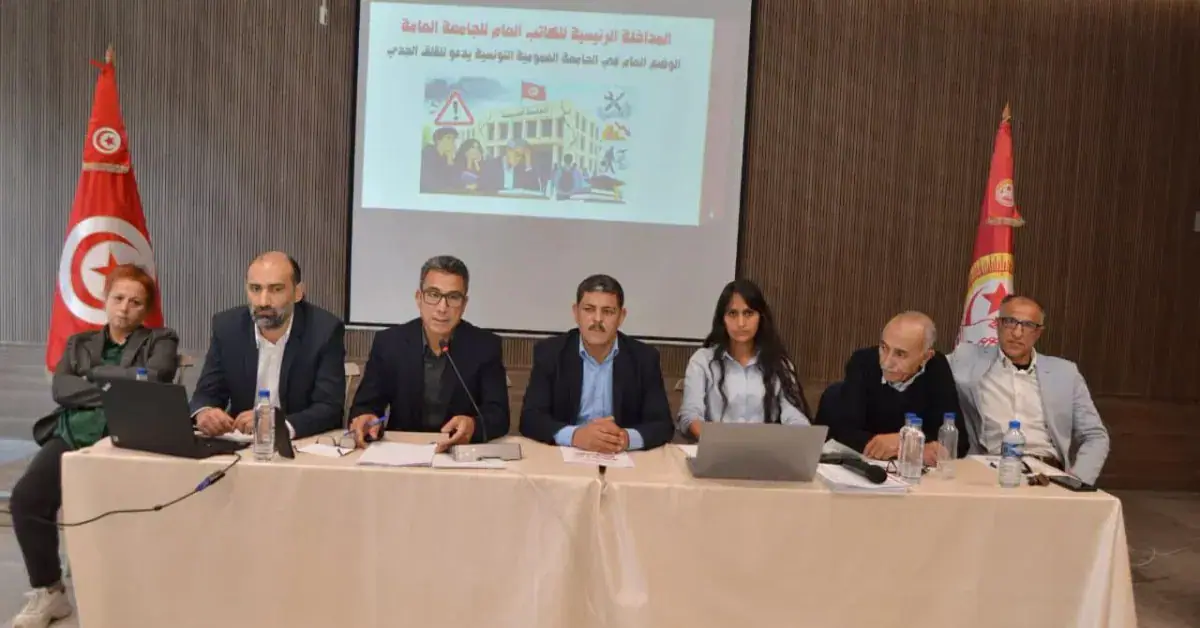
The General Union of Higher Education and Scientific Research in Tunisia has called on the oversight authority to engage in participatory dialogue and provide equal opportunities. The union's Secretary General, Buba Ali, emphasized the need for a collaborative approach to address the files of the higher education sector. He warned that the Tunisian university is at stake due to the lack of dialogue and the monopolization of decision-making by the oversight authority.
During a press conference, Ali rejected the electronic surveys launched by the Ministry of Higher Education to evaluate the basic systems for university students. He argued that these surveys lack guarantees for protecting participants' personal data and represent exclusion of other professional categories, such as distinguished teachers and technologists. The union proposes forming a national committee with elected representatives from pedagogical structures to review the laws governing the sector.
Ali stressed the importance of abandoning the surveys, which may raise concerns about democracy and lead to the adoption of similar methodologies in sensitive areas like personal status and public employment. He also highlighted the need to support national research laboratories, which have decreased in number in recent years. Ali cited the experiences of countries like China and the United States, which have adopted scientific research as a strategic lever.
The union's Secretary General emphasized that promoting scientific research requires providing the necessary material and logistical resources to enable Tunisian university students to contribute to the country's development. He called for a radical change in the approach to higher education and scientific research. The union's proposals aim to improve the quality of education and promote equal opportunities for all.
The Tunisian higher education sector has faced several challenges in recent years, including a lack of resources and infrastructure. The union's call for participatory dialogue and equal opportunities reflects the need for a more inclusive and collaborative approach to addressing these challenges. The sector's future development will depend on the ability of stakeholders to work together to find solutions.
The Ministry of Higher Education has not yet responded to the union's proposals. However, the union remains committed to engaging in dialogue and finding solutions that benefit the sector as a whole. The union's Secretary General emphasized the importance of prioritizing the needs of students and teachers in any future reforms.
The outcome of the union's proposals will have a significant impact on the future of higher education in Tunisia. The sector plays a critical role in shaping the country's human capital and promoting economic development. The union's call for participatory dialogue and equal opportunities reflects the need for a more inclusive and collaborative approach to addressing the sector's challenges.
Key points
- The Tunisian higher education union is calling for participatory dialogue and equal opportunities to address the sector's challenges.
- The union proposes forming a national committee to review the laws governing the sector.
- The union emphasizes the need to support national research laboratories to promote scientific research.