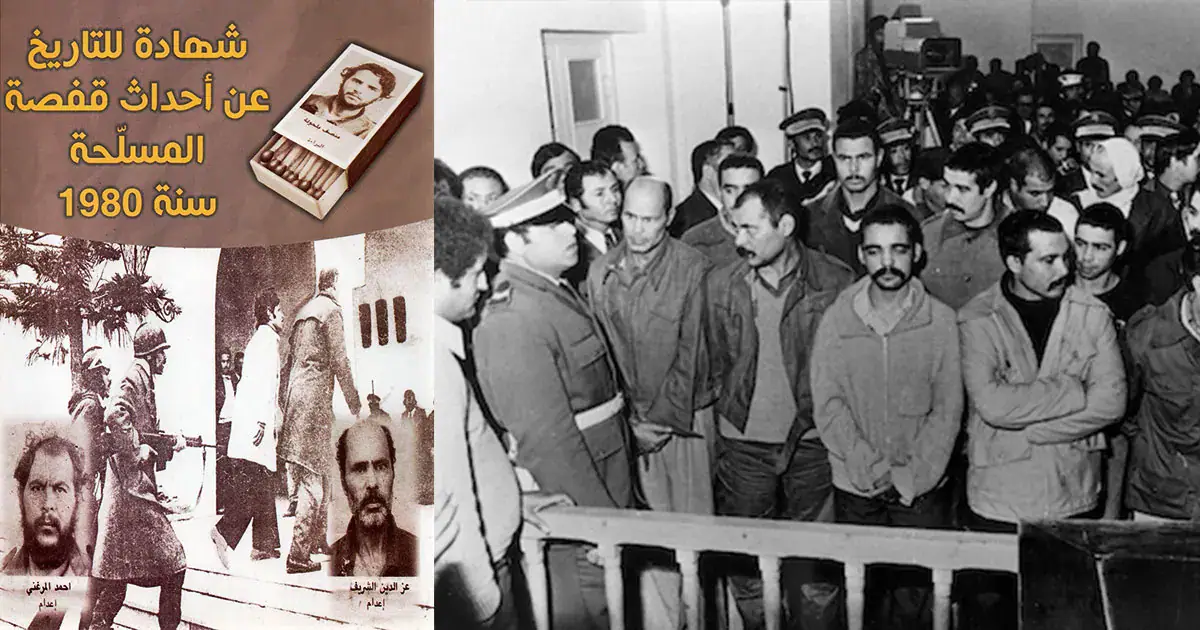
A recent book titled "Un témoignage pour l’histoire sur les événements armés de Gafsa en 1980" by Moncef Belhoula offers a comprehensive look at the 1980 Gafsa uprising in Tunisia. The 325-page book, written in Arabic, is based on the author's firsthand experience as a direct witness to the events. Belhoula's work provides a detailed account of the events leading up to the armed insurrection, allowing readers to piece together the roles of various protagonists involved.
According to the book, the Libyan regime, under Muammar Gaddafi, played a significant role in the events leading up to the uprising. In 1978, Tripoli became convinced that the Tunisian regime was on the brink of collapse and that a push was all it would take to bring it down. Gaddafi's government had cards to play, including Ezzedine Chérif, a survivor of the 1962 Lazhar Chraïti coup attempt, and Ahmed Mergheni, a former Arab nationalist and Palestinian resistance fighter.
The book reveals that Chérif attempted to smuggle arms from Libya into Tunisia in March 1978, but one of the convoys was intercepted by Tunisian authorities, leading to the arrest of Mohamed Salah Marzougui. Chérif then changed strategy, using the Tunisian-Algerian border near Gafsa, which was deemed safer. A Algerian smuggler known as Dhiba took charge of transporting arms through Algeria and into Tunisia.
Mergheni, meanwhile, recruited around 40 Tunisian fighters from Palestinian and pan-Arab organizations in Beirut in November 1979. The recruits were transported to Tripoli, Libya, using fake Libyan and possibly Palestinian passports. However, the plan was compromised, and the recruits were eventually tracked by the Mossad, Israel's intelligence agency.
On January 3, 1980, a commando group consisting of Libyans and Palestinians arrived in Gafsa, hiding in a house in the Ennour neighborhood. The group remained there for over three weeks without arousing suspicion. On January 25, Ezzedine Chérif approached Moncef Belhoula, a trade unionist, to discuss the possibility of establishing a civilian authority in the city, but Belhoula became suspicious and avoided further involvement.
The uprising, initially planned for January 26, was postponed to the night of January 27 due to the absence of local recruits. Only four recruits showed up, and the operation began at 2:30 am with gunfire and an attack by Mergheni's group. The book provides a detailed account of the events, but its conclusions differ from those of the author and Moncef Materi, a former insurgent who saw the uprising as a legitimate struggle against a tyrannical regime.
Dr. Mounir Hanablia notes that while Belhoula condemns the methods used by the insurgents, including violence, murder, and hostage-taking, the book provides a valuable insight into the events of 1980. The author allows readers to form their own opinions, and the book serves as a valuable historical testimony to the events that took place in Gafsa in 1980.
Key points
- The book "Un témoignage pour l’histoire sur les événements armés de Gafsa en 1980" provides a detailed account of the 1980 Gafsa uprising in Tunisia.
- The Libyan regime played a significant role in the events leading up to the uprising.
- The uprising was ultimately unsuccessful, and its consequences remain a topic of discussion among historians and analysts.