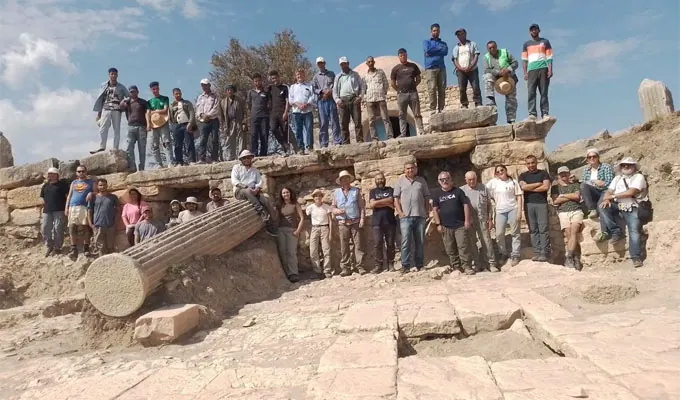
The Tunisian National Heritage Institute (INP) has made a significant archaeological discovery in the ancient city of Numluli, located in Henchir Matria, north of Teboursouk in the Béja governorate. The excavation, which took place from September 6 to October 4, 2026, uncovered a Roman Capitol and a Vandal basilica. The project was carried out in collaboration with the University of Sassari in Italy and involved researchers and students from various academic levels.
The Roman Capitol, built in 170 BC, was found in the first sector of the excavation site. The team discovered the paving of the public square, a fountain, and numerous architectural and decorative elements of the temple, including capitals, columns, and geometric decorations. These artifacts date back to the Roman period and provide valuable insights into the history of the city. The excavation also uncovered fragments of statues and other relics.
The second sector of the excavation site revealed a Vandal basilica constructed in the mid-5th century AD. The basilica contains Christian tombs, various rooms, walls, and funerary jars, as well as jars used for storing provisions. The team also discovered mosaic panels, which are significant finds for understanding the culture and art of the time. The basilica is an important discovery, as it sheds light on the history of Christianity in the region.
The excavation project was a collaborative effort between the INP and the University of Sassari in Italy. The team consisted of researchers and students from various academic levels, who worked together to study and preserve the two main sectors of the ancient city. The project demonstrates the importance of international cooperation in archaeological research and highlights the significance of preserving cultural heritage.
The discovery of the Roman Capitol and Vandal basilica is a significant addition to Tunisia's rich cultural heritage. The findings provide valuable insights into the history of the region, from the Roman period to the Vandal era. The excavation project has also provided an opportunity for researchers and students to gain hands-on experience in archaeological research and preservation.
The INP has announced that the excavation project has been completed, but further research and analysis of the findings are ongoing. The discovery of the Roman Capitol and Vandal basilica is expected to attract tourists and scholars interested in history and archaeology. The site is expected to be preserved and protected for future generations to appreciate and learn from.
The Tunisian government has been working to promote cultural tourism and preserve the country's rich heritage. The discovery of the Roman Capitol and Vandal basilica is a significant step in this direction. The site is a testament to the country's rich history and cultural diversity, and its preservation will help to promote tourism and economic development in the region.
Key points
- The Roman Capitol was built in 170 BC and features a well-preserved public square and fountain.
- The Vandal basilica was constructed in the mid-5th century AD and contains Christian tombs and mosaic panels.
- The excavation project was a collaborative effort between the INP and the University of Sassari in Italy.