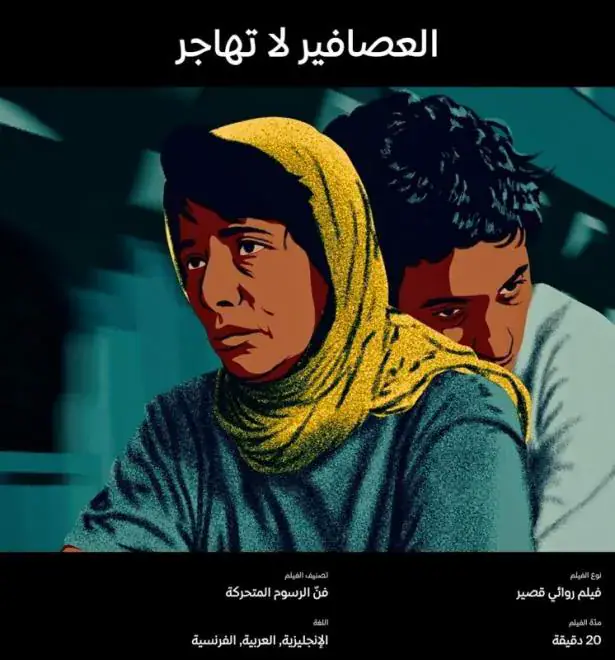
The Tunisian animated film, The Bird's Placebo, directed by Rami Jarboui, has garnered attention from critics and the Algerian press after being featured in the official competition at the 2nd International Short Film Festival in Timimoun, Algeria. The film sparked discussions about its philosophical and humanitarian themes, particularly its exploration of freedom in the contemporary world. Jarboui's work is a cinematic journey that searches for universal freedom amidst the constraints of reality and existential questions.
The idea for The Bird's Placebo began to take shape during the latter part of the COVID-19 pandemic, when Jarboui experienced feelings of isolation and confinement, compounded by the loss of a family member. This led him to explore the duality of life and death, and the meaning and limits of freedom in a social and human reality where young people's prospects are dwindling. The film also draws on a real-life story that Jarboui recalls from his past, about a Tunisian youth who attempted irregular migration and faced difficulties during the Tunisian revolution.
The film's narrative is not limited to the Tunisian context, but rather extends to broader humanitarian issues, including the experiences of migrants in Western countries who face discrimination and racism. Jarboui cites the concept of "double absence" by Algerian writer Abdelmalek Sayad, which describes the state of being a migrant who is absent from both their homeland and their new environment. The film employs symbolism, particularly through the image of a bird and its cage, which is repeated at different levels of the story.
The Bird's Placebo features a unique blend of animation techniques, including rotoscoping, which involves filming live actors and then transforming their movements into animated drawings. Jarboui chose this approach to preserve the human presence of the characters, emphasizing the importance of emotional expression and physical performance in building the film. The production process took around two and a half years, with a team of Tunisian animators working on the project.
The film's cast includes actors such as Mohamed Hussein Qareei, Fatma Al-Falhi, and Yassin Bradai, who drew on their theater experience to build their performances. Jarboui stresses that technology should serve the script and artistic vision, rather than being the primary focus. He also believes that artificial intelligence is not a substitute for specialized cinematic work, and that the film's production was based on manual labor and creative vision.
The Bird's Placebo has been featured in several international film festivals, including Sundance, Clermont-Ferrand, and the Cairo International Film Festival. The film has won awards at various festivals, including the first prize at the Gabes Festival. Jarboui's work is seen as a testament to the independence of Tunisian cinema and its ability to address universal themes from a unique perspective.
Jarboui's commitment to working with a Tunisian team and promoting local animation talent was a deliberate choice, despite receiving offers to collaborate with international partners. He believes that independent cinema must preserve the freedom of the author to choose their ideas and build their vision of the world, while still being able to reach an international audience. The film's success demonstrates the potential for Tunisian animation to produce high-quality, thought-provoking content that resonates with global audiences.
Key points
- The Bird's Placebo explores themes of freedom, existentialism, and human connection through a unique blend of animation techniques and real-life experiences.