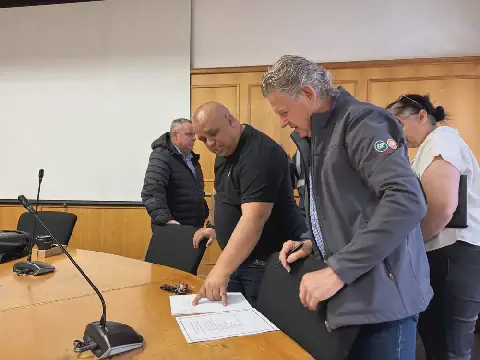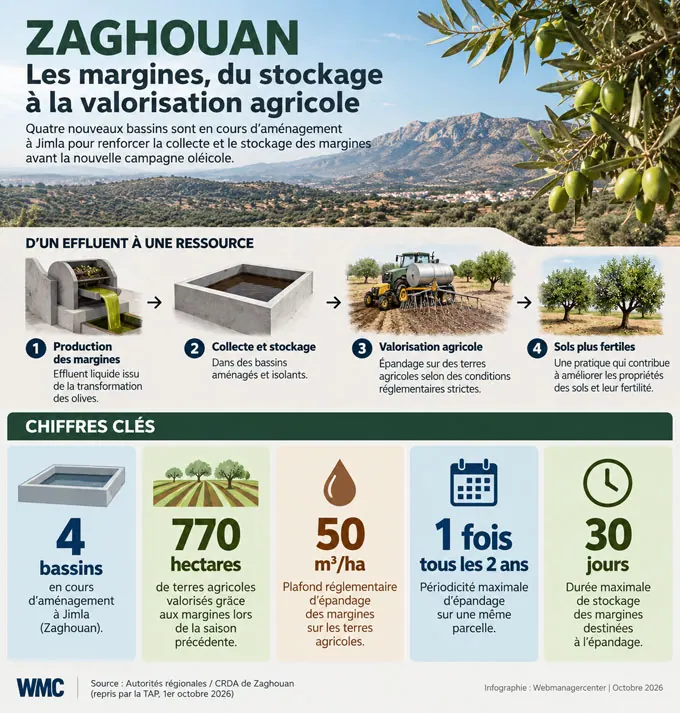
In the Tunisian region of Zaghouan, four new basins are being built to collect and store margines, a liquid byproduct of olive oil production. The project, inspected by Governor Karim Brengi, aims to transform this waste into a valuable agricultural resource while adhering to strict environmental conditions. The construction work involves terracing and preparing the sites to accommodate the margines produced during the upcoming olive harvest season.
The initiative goes beyond mere storage, as the collected quantities will be used to fertilize agricultural land. In the previous season, nearly 770 hectares of farmland in Zaghouan benefited from the valorization of margines, which helped improve soil properties and fertility. This practice is heavily regulated, with a maximum allowed dose of 50 cubic meters per hectare, and can only be applied once every two years on the same plot.
The Tunisian decree n° 2013-1308 sets strict guidelines for the use of margines, including storage in isolated basins and a maximum storage duration of 30 days. The practice is limited to perennial crops such as olive trees, vines, and fruit trees, and includes several restrictions to protect water sources, crops, and residential areas.
The Zaghouan region is taking a concrete step towards circular economy by collecting, storing, and potentially reusing margines on agricultural land. However, several key data points are still missing to assess the project's economic impact, including the total capacity of the new basins, their construction cost, the annual volume of margines produced, and the cost of valorization per hectare.
The project's success will depend on its ability to be economically viable and scalable. With the necessary data, it will be possible to evaluate the cost of the system, its potential coverage rate, and its capacity to expand. For now, the infrastructure is being put in place, but its economic effectiveness remains to be measured.
Zaghouan's initiative is part of a broader effort to promote sustainable agriculture and reduce waste in Tunisia. The region's focus on valorizing margines could serve as a model for other areas with similar olive oil production activities. Further information will be needed to determine the project's long-term impact and potential for replication.
The development of these four basins in Jimla is a significant step towards reducing the environmental impact of olive oil production in Tunisia. By providing a controlled and regulated system for managing margines, the project aims to promote sustainable agricultural practices while supporting the local economy.
Key points
- Four new basins are being built in Zaghouan to collect and store margines for use as an agricultural resource.
- The project aims to promote sustainable agriculture and reduce waste in Tunisia's olive oil production sector.
- The economic impact of the project remains to be evaluated, with key data points still missing.