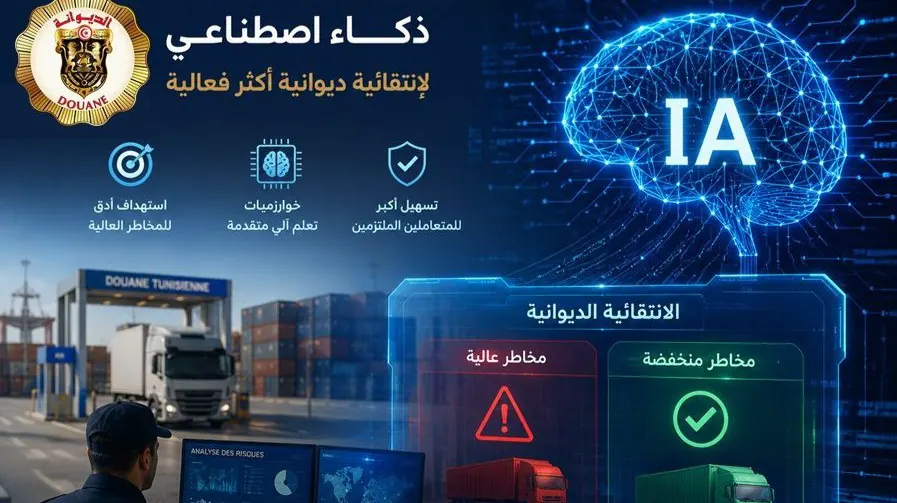
Tunisia's customs authority, the General Directorate of Customs, is set to leverage artificial intelligence and machine learning technologies to enhance its risk-based clearance of high-risk permits and files. The move aims to analyze large amounts of data and target high-risk permits and files, allowing for more efficient allocation of monitoring efforts. This approach will enable the customs authority to focus on priority cases while ensuring that the expertise of human officers is not replaced.
The project was presented at a national conference organized by the National School of Finance and the National School of Customs. During the conference, the Director of Risk Management at the General Directorate of Customs, Essam Al-Fasatwi, showcased a machine learning model that analyzed data from 2025 and detected additional amounts worth approximately 96.9 million dinars, with a detection rate of 49.23%. The model was based on 11 million observations and 27 primary variables, which were enriched with composite variables to reach 42 variables.
The customs authority's experience relies on integrating monitoring results into the periodic retraining and updating of the model, allowing for a shift from static selectivity based on predefined rules to dynamic selectivity that benefits from data and previous monitoring results. In the tax field, the Director General of the Information Center at the Ministry of Finance, Salah Al-Madab, presented a project to use big data and machine learning to improve the targeting of tax monitoring.
The project aims to identify high-risk files and allocate resources more effectively. It also seeks to enhance the administration's ability to monitor the informal economy, unregistered individuals, and new forms of digital activity. Additionally, the project aims to provide decision-making tools and combat complex fraud patterns. The project is currently in the bidding stage, with an expected implementation period of one year.
The technical infrastructure will be based on a local architecture and open-source tools, allowing for the reuse of experience in other areas of public finance. The General Director of Performance at the General Directorate of Performance, Moez Dalloul, highlighted that digitalization has reduced physical and repetitive tasks, freeing up time for monitoring and analysis. He noted that the number of remote declarants has reached 157,000.
The automated processing of landlord permits has saved around 8,000 working days, and the increasing volume of data from electronic invoicing and registered boxes requires the development of the administration's capacity to process and analyze it. Artificial intelligence can help improve service quality, verify data consistency, and link transactions between different stakeholders.
The conference discussed the challenges of artificial intelligence in finance, taxation, customs, and accounting, as well as change management and ethics in using these technologies. The event also explored the role of training institutions in qualifying competencies and keeping pace with sectoral transformations. Key points include:
Key points
- The use of artificial intelligence and machine learning to enhance risk-based clearance of high-risk permits and files.
- The integration of monitoring results into the periodic retraining and updating of the model.
- The development of competencies and skills in statistics, data analysis, and understanding model outputs.