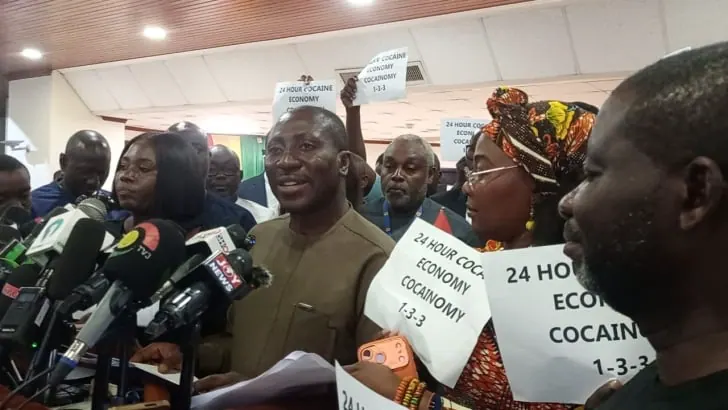
On Tuesday, September 29, 2026, Minority Leader Alexander Afenyo-Markin expressed disappointment with Speaker Alban Sumana Kingsford Bagbin's ruling to reject a Private Member's Motion. The motion sought a parliamentary inquiry into a series of narcotics seizures linked to Ghana. Afenyo-Markin, the Effutu MP, argued that the Speaker's decision improperly restricted Parliament's constitutional mandate to scrutinize public institutions connected to the incidents.
Afenyo-Markin described the development as "a sad day for democracy and parliamentary oversight". He accused the Majority Caucus of relying on its numerical strength, with the support of the Speaker, to limit Parliament's ability to exercise its oversight responsibilities. According to him, the Speaker's ruling failed to explain how the matters before the court ousted the constitutional jurisdiction of Parliament to enquire into the conduct, administration, and effectiveness of public institutions involved.
The Minority Leader maintained that the motion was not intended to interfere with criminal proceedings or determine the guilt or innocence of anyone facing prosecution. Rather, it aimed to determine whether public institutions responsible for preventing and combating narcotics trafficking had effectively performed their duties. He cited Articles 93(2) and 103 of the 1992 Constitution as the basis for Parliament's legislative and oversight functions.
Afenyo-Markin pointed specifically to Article 103(3), which empowers parliamentary committees to investigate and inquire into the activities and administration of ministries, departments, and agencies. He also referred to Article 103(6), which gives parliamentary committees powers, rights, and privileges similar to those of the High Court. These provisions, he argued, are important because the motion did not seek to try any accused person or determine criminal liability.
The proposed inquiry would have investigated the operations of institutions responsible for narcotics control, customs administration, port and airport security, intelligence gathering, maritime surveillance, and border protection. Afenyo-Markin acknowledged that Parliament and the courts have different constitutional responsibilities, arguing that the existence of criminal cases should not automatically prevent Parliament from examining the performance of public institutions.
Afenyo-Markin challenged the interpretation of the subjudice principle applied in rejecting the motion. He argued that the proper question is not simply whether a matter is before a court, but whether the proposed parliamentary investigation could prejudice the outcome of those proceedings. He suggested that Parliament could have established safeguards to ensure that the proposed committee did not investigate the guilt or otherwise of accused persons.
The Minority Leader said such measures would have enabled Parliament to carry out its oversight mandate while respecting the authority and independence of the courts. The inquiry could have concentrated on various institutional systems, including container scanning procedures, customs control, and intelligence sharing. He emphasized that these systems are not on trial and that the inquiry would have focused on institutional oversight.
Key points
- The Minority Leader criticized the Speaker's decision as "a sad day for democracy and parliamentary oversight".
- The proposed inquiry aimed to determine whether public institutions responsible for preventing and combating narcotics trafficking had effectively performed their duties.
- Afenyo-Markin argued that the existence of criminal cases should not automatically prevent Parliament from examining the performance of public institutions.