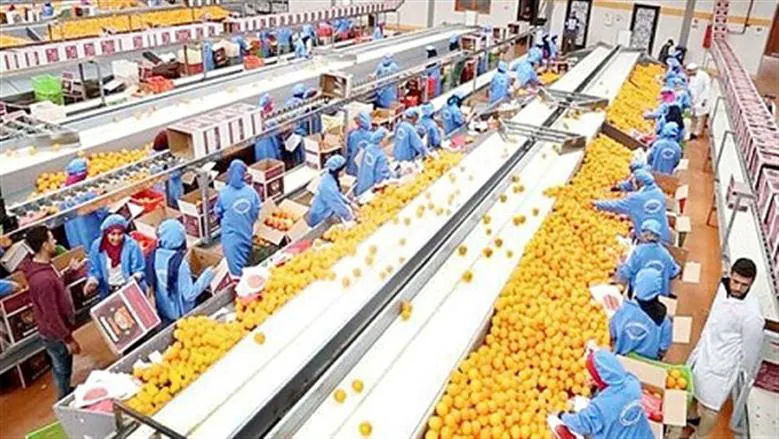
The Egyptian government has released data showing that the country's exports have diversified across various sectors, including agriculture, food industries, chemicals, fertilizers, petroleum products, and jewelry. According to the Central Agency for Public Mobilization and Statistics, these sectors represent a significant portion of Egypt's export activity. The government's efforts to support export companies and enhance their competitiveness in foreign markets have contributed to this growth.
In 2023, Egypt's total exports were valued at $42.6 billion, increasing by 6.5% to $45.3 billion in 2024. Non-oil exports accounted for approximately $41.5 billion in 2024. The growth trend continued in 2025, with total exports rising by 21.7% to reach $51.4 billion. Non-oil exports alone totaled $48.56 billion in 2025. The agricultural sector, particularly citrus fruits, played a significant role in Egypt's export growth.
The agricultural sector has maintained its importance in Egypt's export landscape, with products like potatoes, sweet potatoes, onions, and strawberries contributing significantly. The food industry has also seen substantial growth, with frozen fruits, beverage concentrates, and edible oils being major export items. The chemical and fertilizer sectors have benefited from large-scale production within Egypt's industrial facilities.
Egypt's petroleum products and crude oil exports continue to be a significant component of its trade. These products have shown considerable gains on an annual basis. The jewelry and precious stones sector has also emerged as a high-value export segment, particularly with Egypt's expanding trade relations with BRICS countries.
The engineering and electronics sectors have contributed to Egypt's export growth, with products like insulated wires, electrical cables, and automotive components being key export items. Despite a seasonal decline in non-oil exports in the first quarter of 2026, the second quarter saw a strong rebound. Egypt's non-oil exports reached $10.8 billion in the first quarter and $12.5 billion in the second quarter.
The Ministry of Finance has focused on providing liquidity to exporters and settling outstanding financial claims. In August and September 2025, the government disbursed 5.3 billion Egyptian pounds to 2447 exporting companies. The ministry has allocated 28 billion Egyptian pounds in the current fiscal year's budget to support exports, representing a 55% annual increase.
Key export markets for Egypt include Saudi Arabia, the United Arab Emirates, Turkey, and Italy. Saudi Arabia has been a leading importer of Egyptian goods, with annual imports exceeding $3.4 billion. The UAE and Turkey have also been significant markets, with average annual imports of $3.3 billion and $2.9 billion, respectively.
Key points
- Egypt's total exports are projected to reach $51.4 billion by 2025.
- Non-oil exports accounted for $48 billion of Egypt's total exports in 2025.
- The Egyptian government has allocated 28 billion Egyptian pounds to support exports in the current fiscal year.