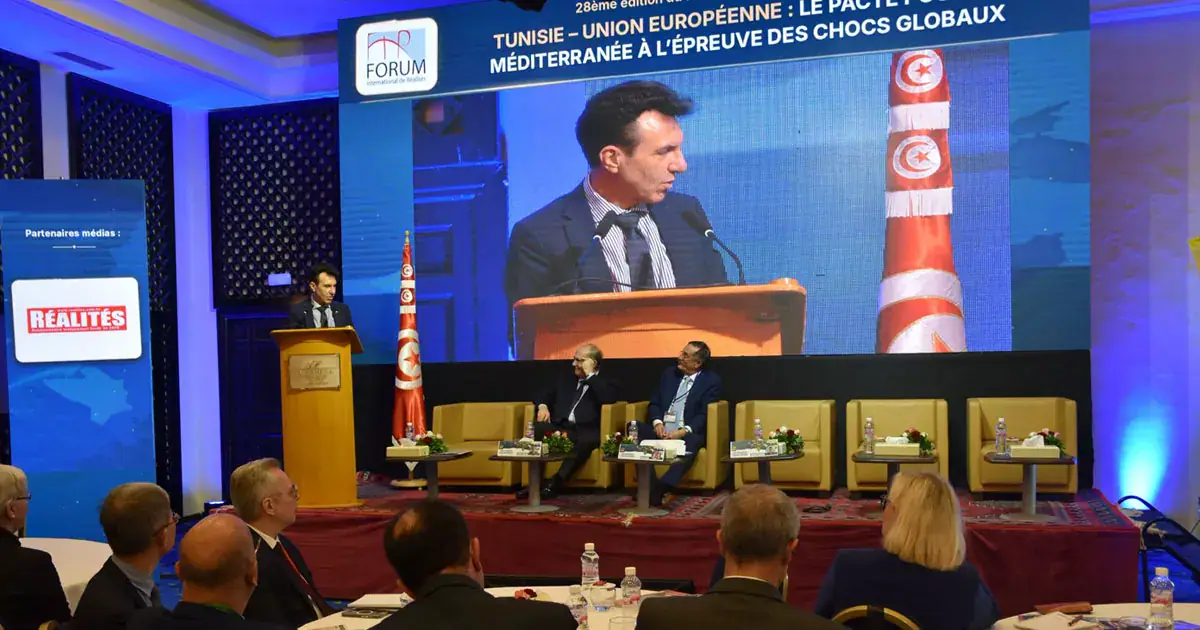
The European Union is set to unveil a new version of its Pact for the Mediterranean plan, with Tunisia playing a leading role, according to EU ambassador to Tunisia Giuseppe Perrone. Speaking at the 28th edition of the International Forum of Réalités in Hammamet, Perrone stated that the pact aims to move beyond crisis management and build a strategic partnership that can anticipate emergencies and find common solutions. This partnership seeks to enhance prosperity, stability, and security on both sides of the Mediterranean.
Perrone highlighted the impact of international conflicts on prices, energy costs, and supply chains, as well as the challenges posed by ecological transition, digitalization, and artificial intelligence. He emphasized that the Pact for the Mediterranean is a distinct instrument from the Association Agreement between Tunisia and the EU, signed in 1995. While the agreement primarily governs bilateral trade relations, the pact is a regional strategic initiative aimed at promoting sustainable, inclusive, and resilient growth.
The first action plan of the Pact, presented by the European Commission on April 17, comprises 21 initiatives in areas such as training, mobility, economic cooperation, security, and regional integration. Perrone's announcement suggests that the upcoming document will be an operational update rather than a revision of the Association Agreement. This update may be followed by a specific dialogue between Brussels and Tunis.
Italian ambassador Alessandro Prunas also discussed the EU's Pact for the Mediterranean, describing it as a new partnership between Mediterranean countries based on equal relations and mutual benefits. Prunas cited the legacy of Enrico Mattei, an Italian industrialist and politician, whose plan for Africa, launched in 2023, shares a similar vision. The Italian ambassador mentioned the Elmed project, which aims to reshape the Mediterranean's energy landscape based on shared interests and mutual benefits.
The Pact for the Mediterranean is designed to address the complex challenges facing the region, including economic, environmental, and security concerns. By fostering cooperation and coordination among Mediterranean countries, the pact seeks to promote stability and prosperity in the region. Tunisia's involvement in the pact is seen as crucial, given its strategic location and economic importance.
The upcoming presentation of the new plan d'action du Pacte pour la Méditerranée is expected to outline specific initiatives and projects aimed at addressing the region's challenges. While details of the plan remain scarce, Perrone's announcement suggests that it will build on the existing framework and seek to strengthen cooperation between Mediterranean countries.
The Pact for the Mediterranean reflects the EU's commitment to enhancing its partnership with countries in the region, based on shared interests and mutual benefits. As Tunisia prepares to play a key role in the pact, the country's government will need to navigate the complexities of the initiative and ensure that its interests are represented. The success of the pact will depend on the ability of Mediterranean countries to work together and address the region's pressing challenges.
Key points
- The EU's Pact for the Mediterranean aims to promote sustainable, inclusive, and resilient growth in the region.
- Tunisia is set to play a leading role in the pact, which seeks to address emergencies and find common solutions.
- The pact is a distinct instrument from the Association Agreement between Tunisia and the EU, signed in 1995.