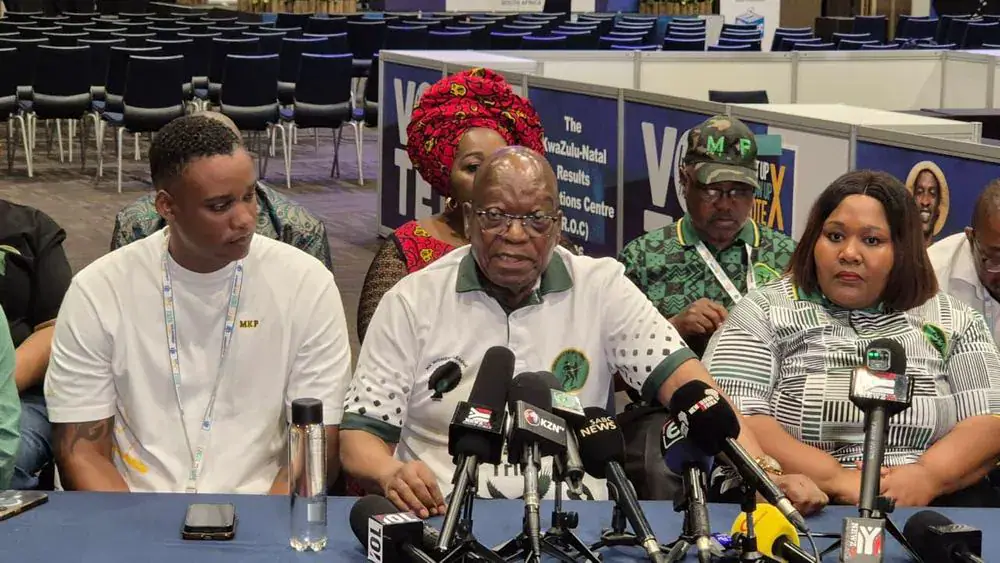
The MK Party, led by Jacob Zuma, has ruled out forming a coalition with the Democratic Alliance (DA) after the November 4 local government elections. Instead, the party will focus on engaging with black parties that share its values and vision for South Africa, including the African National Congress (ANC), Inkatha Freedom Party (IFP), and Economic Freedom Fighters (EFF). Advocate Dali Mpofu stated that the DA has made it clear they are not willing to work with the MK Party.
Mpofu revealed that Zuma has instructed the party leadership to begin coalition discussions with other political formations as soon as possible. The party's approach to coalition negotiations is informed by the election outcome, with over 120 of the country's 257 municipalities expected to require coalition arrangements. This has resulted in almost half of the country's municipalities facing hung councils, making cooperation between parties necessary.
The MK Party's internal documents outline its broader political outlook, including the return of land, which will inform its approach to potential coalition partners. Mpofu emphasized that the party's natural affinity will be with formations that share its values and vision for a future South Africa. The party is open to talks with various players willing to engage, including the ANC, IFP, ActionSA, EFF, African Transformation Movement (ATM), and South African Communist Party (SACP).
Mpofu pushed back against concerns that the MK Party's participation in coalition governments could affect political stability. He argued that voters have already made their decision at the ballot box and criticized the media's preoccupation with stability. The party's performance in the elections shows that voters have given it a significant mandate, despite being less than three years old and contesting local government elections for the first time.
The MK Party secured a 10% share of the national vote, which Mpofu described as unprecedented for a party entering local government elections for the first time. He rejected suggestions that the party had lost support in KwaZulu-Natal compared with the 2024 national and provincial elections. Mpofu argued that the two elections cannot be directly compared due to their different nature.
Mpofu defended the party's election performance, pointing to the ANC's loss of 14 percentage points and the DA's increase of just over two percentage points. He argued that the MK Party's gains account for 10 percentage points of the decline in support for the Government of National Unity partners. Mpofu maintained that the correct comparison would be between local government elections, rather than comparing the party's performance in the 2024 national and provincial elections with its performance in 2026.
The MK Party's results in KwaZulu-Natal stand at approximately 34.5% with about 97% of the results processed, compared with the 45% it received in KwaZulu-Natal in 2024. Mpofu emphasized that the party has grown from having no representation in local government elections to securing a 10% share of the national vote. The party's focus on coalition talks with like-minded parties is expected to shape its approach to governance in the municipalities.
Key points
- MK Party prioritizes coalition talks with black parties, excluding DA
- Party's performance in elections shows significant mandate from voters
- MK Party's gains account for 10 percentage points of decline in GNU partners' support