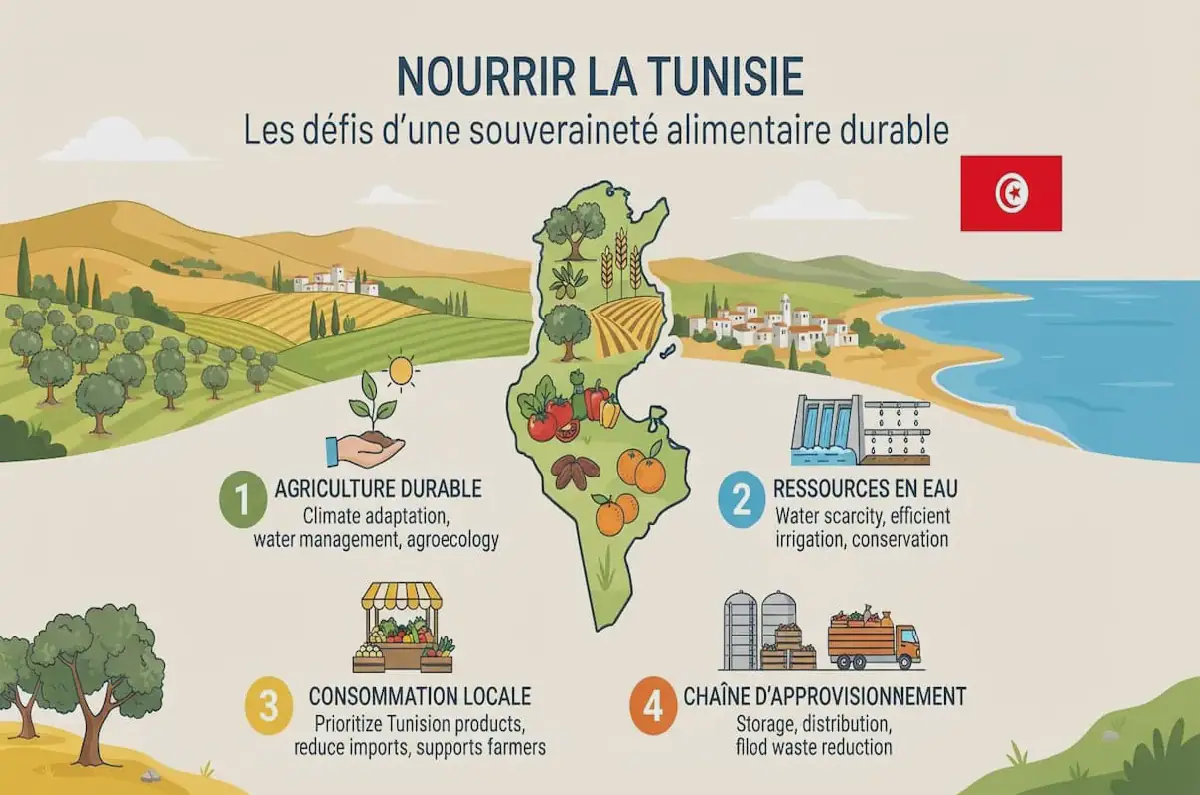
Tunisia's food sovereignty is under threat due to a combination of factors, including its reliance on imports, water scarcity, energy shortages, and increasing costs. The country's budget constraints and declining purchasing power have exacerbated the issue, making it challenging to ensure a stable food supply. According to the 2026 finance law, the state's budget is set at 52,560 billion dinars in revenue and 63,575 billion dinars in expenditure, with a deficit financing need of 11,015 billion dinars.
The 2026 finance law, promulgated on December 12, 2025, outlines the state's financial priorities, but it remains to be seen whether the allocated funds for agriculture will be sufficient to address the sector's challenges. The law provides for a 10-million-dinar financing line for small farmers, offering favorable seasonal credits for the 2025-2026 campaign. Additionally, a mechanism for rescheduling small agricultural debts is established, with the full waiver of late interest. However, the effectiveness of these measures depends on their implementation and accessibility.
To strengthen food sovereignty, Tunisia needs to prioritize investments that limit agricultural losses, increase national production capacity, and reduce dependence on food imports. One strategy is to secure reliable electricity supply for farms, particularly for critical installations such as poultry farms, dairy farms, and irrigation systems. A national program for agricultural electrical resilience could provide targeted support for generators, automatic transfer systems, and monitoring devices.
Another key area of focus is rebuilding the country's livestock capacity, particularly in the dairy and meat sectors. Targeted measures could include seasonal credits, investment support, and access to animal feed and fodder. Health programs, reproduction improvement, and faster payments in the dairy chain could also help. The goal is to promote sustainable agricultural practices and reinforce the resilience of small and medium-sized farms.
Reducing dependence on cereal imports is also crucial, and efforts should focus on improving crop yields and storage capacity. This could involve investments in irrigation systems, agricultural research, and extension services. Furthermore, supporting small-scale farmers and promoting local food systems could help increase food availability and reduce reliance on imports.
The Tunisian government faces significant challenges in achieving food sovereignty, but there are opportunities for improvement. By prioritizing investments in agriculture, energy, and water management, the country can reduce its vulnerabilities and strengthen its food systems. International cooperation and support could also play a crucial role in helping Tunisia address its food security challenges.
Ultimately, achieving food sovereignty in Tunisia will require a comprehensive and multi-faceted approach that addresses the country's environmental, economic, and social challenges. By adopting a strategic and coordinated approach, Tunisia can build a more resilient food system and ensure a stable food supply for its citizens.
Key points
- Tunisia's 2026 finance law allocates 10 million dinars for small farmers and establishes a mechanism for rescheduling small agricultural debts.
Reporting sources
- Nourrir la Tunisie : les défis d’une souveraineté alimentaire durable (4/4) · L'Économiste maghrébin