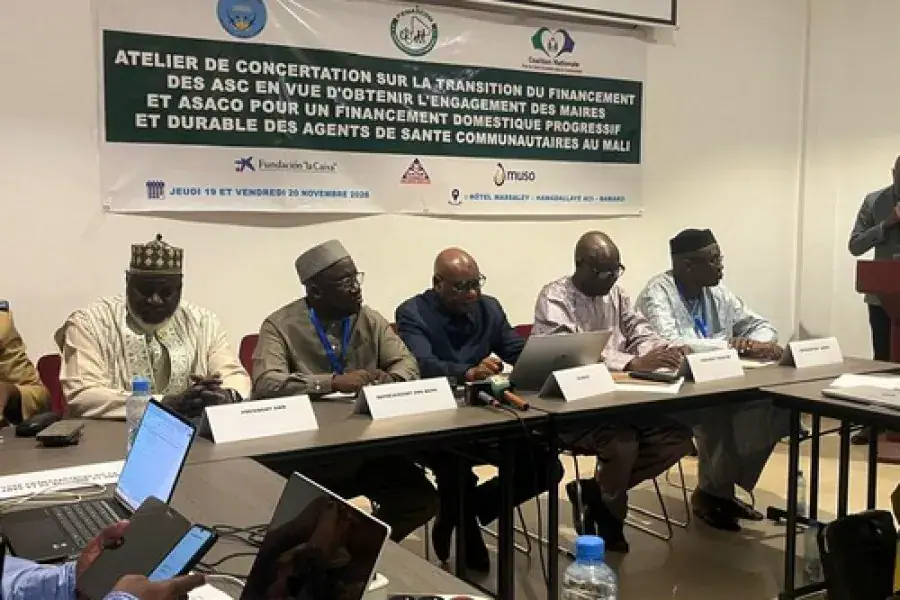
The Malian government recently hosted a two-day workshop on sustainable financing for community health, bringing together key stakeholders from the health sector. The event, which took place on November 19-20, 2026, aimed to discuss the challenges and opportunities in financing community health. The workshop was attended by the Chief of Staff of the Ministry of Health and Social Development, Abdoulaye Guido, as well as representatives from non-governmental organizations and civil society groups.
The Coordinator of the non-governmental organization Muso, Diomé Diakité, highlighted the crucial role that community health workers play in the healthcare system, accounting for 14% of national healthcare provision. He emphasized the need for sustainable financing to support these workers and improve healthcare outcomes. Diakité's sentiments were echoed by Yaya Zan Konaré, President of the Federation of National Associations of Community Health Workers (FENASCOM), who noted that despite progress in the health sector, community health workers face significant challenges, including funding constraints.
Konaré called for sustainable financing to strengthen the governance of community health associations and improve health indicators at the community level. He also paid tribute to the pioneers of community health in Mali, acknowledging their contributions to the sector. Abdoulaye Guido, Chief of Staff of the Ministry of Health and Social Development, underscored the importance of the workshop, emphasizing the need for collective engagement in progressive and sustainable domestic financing for community health workers.
Guido provided an overview of Mali's experience in community health, citing the 1978 Alma Ata conference and the 1987 Bamako Initiative, which laid the groundwork for community participation in healthcare. He noted that Mali currently has 1,821 community health centers, 4,321 community health worker sites, and over 1,500 rural maternity centers. The government has also implemented reforms since 1990, including the adoption of a sectoral health policy and the recognition of community health workers as a key component of the healthcare system.
The workshop aimed to identify solutions for sustainable financing of community health, with participants expected to develop a roadmap for implementation. The coalition of national associations for the promotion of community health and FENASCOM presented a memorandum to the ministry, outlining their proposals for sustainable financing. The government has prioritized funding for community health workers' salaries, despite facing significant challenges.
Community health workers have been recognized as a vital component of Mali's healthcare system, providing essential services to rural and underserved communities. The workshop highlighted the need for increased support and resources to ensure the long-term sustainability of community health programs. Stakeholders emphasized the importance of collaboration and coordination to address the challenges facing community health workers.
The outcome of the workshop is expected to inform policy decisions on sustainable financing for community health in Mali. The Ministry of Health and Social Development is expected to consider the proposals and recommendations presented during the workshop, with the aim of improving healthcare outcomes for communities across the country. Key stakeholders will continue to engage in discussions on sustainable financing for community health, with a focus on ensuring that community health workers receive the support they need to provide quality services.
Key points
- The Malian government has prioritized funding for community health workers' salaries, despite facing significant challenges.
- Community health workers account for 14% of national healthcare provision in Mali.
- The workshop aimed to identify solutions for sustainable financing of community health, with participants expected to develop a roadmap for implementation.