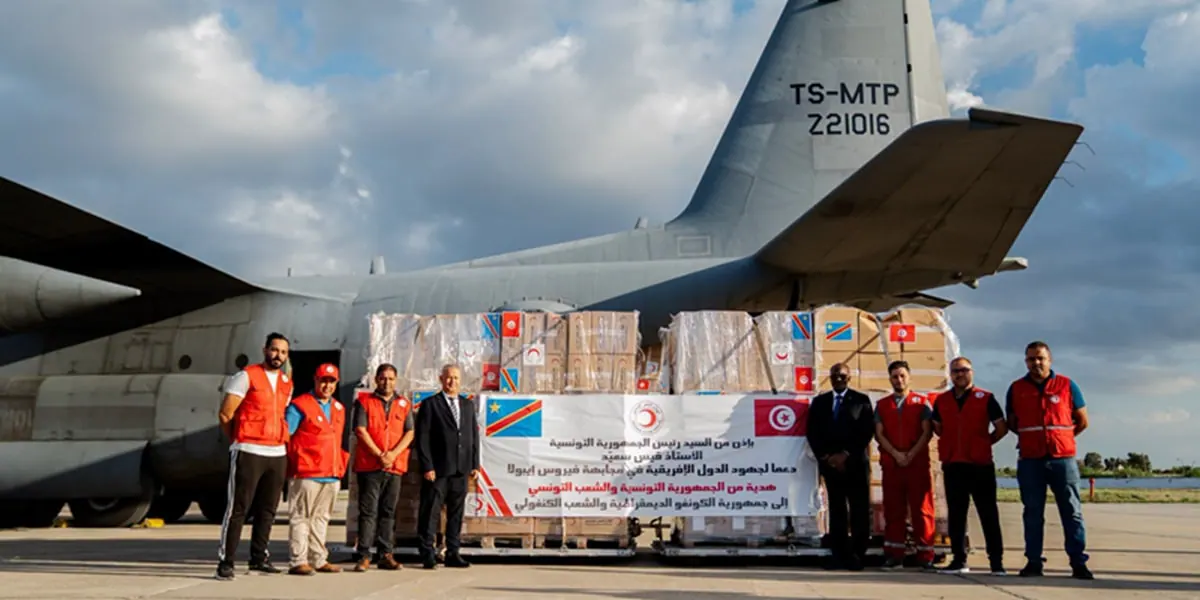
The Tunisian government has sent a shipment of medical supplies and equipment to the Democratic Republic of Congo (DR Congo) to help combat the ongoing Ebola epidemic. The aid, which includes a significant quantity of medicine and medical equipment, was transported on a military plane that departed on September 22, 2026, and arrived at Kinshasa's international airport. The Ministry of Foreign Affairs, Migration, and Tunisians Abroad confirmed the shipment.
The medical aid was made possible through the collaboration of several Tunisian departments and organizations, including the Ministries of Foreign Affairs, National Defense, Health, and Social Affairs, as well as the Tunisian Red Crescent and the Tunisian Union of Social Solidarity. The Ministry of National Defense oversaw the loading and transportation of the aid, while the Tunisian Embassy in Kinshasa will supervise its handover to the Congolese authorities.
The Ebola epidemic in DR Congo continues to spread, with the World Health Organization (WHO) reporting 7,733 confirmed cases and 3,732 deaths as of September 20, 2026, representing a crude fatality rate of 48.3%. The epidemic has now affected 63 health zones, with the WHO noting that the situation remains concerning, particularly in the provinces of Ituri, North Kivu, and Haut-Uele.
The WHO has reported that the epidemic is showing signs of slowing down in some areas, but the appearance of new cases in previously unaffected zones maintains the risk of further geographical expansion. The organization is working closely with the Congolese authorities and partners to strengthen surveillance, treatment, and response capacities.
The Tunisian government's decision to send medical aid to DR Congo reflects its commitment to supporting international efforts to combat the Ebola epidemic. The aid shipment is expected to help bolster the capacity of Congolese health authorities to respond to the crisis.
The Ebola epidemic in DR Congo has been ongoing since the outbreak was declared in August 2026. The virus responsible for the epidemic is the Ebola Bundibugyo virus, which is a strain of the Ebola virus that was first identified in 2002. The WHO has been working closely with the Congolese authorities to respond to the epidemic.
The international community has been providing support to DR Congo to help combat the epidemic, including financial, technical, and medical assistance. The WHO has also been working to strengthen global preparedness and response to the epidemic, including through the deployment of experts and resources to affected areas.
Key points
- The Tunisian government's shipment of medical aid to DR Congo includes a significant quantity of medicine and medical equipment to help combat the Ebola epidemic.
- The Ebola epidemic in DR Congo has affected 63 health zones and resulted in 7,733 confirmed cases and 3,732 deaths as of September 20, 2026.
- The WHO is working closely with the Congolese authorities and partners to strengthen surveillance, treatment, and response capacities to combat the epidemic.