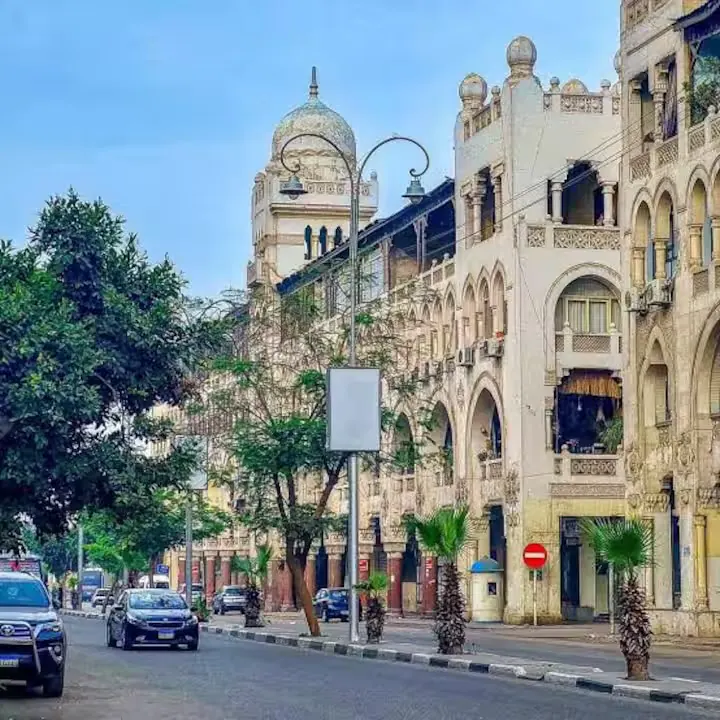
The Heliopolis neighborhood in Cairo is undergoing a transformation with a new pedestrian-only street project on Ibrahim Pasha Street. The project, which covers roughly 250 meters, includes infrastructure and telecommunication upgrades, restoration of 64 shop facades and 13 buildings with distinctive architectural character, and standardization of commercial signs. The Ministry of Local Development consulted with residents and business owners before work began, aiming to revive the neighborhood's historic character. This initiative is part of a larger effort to revitalize public spaces in Cairo.
The history of Heliopolis dates back to 1905 when Édouard Empain and Boghos Nubar Pasha secured a concession to develop thousands of acres outside Cairo. The Heliopolis Oasis Company was established in 1906, with a plan to integrate housing, business, recreation, gardens, and infrastructure. The tramway was central to this plan, connecting Heliopolis to Cairo and shaping the suburb's physical and social character. The neighborhood's eclectic aesthetic, influenced by Persian, Moorish, and European styles, attracted ethnic and religious minorities, creating a diverse and cohesive community.
Heliopolis was conceived as an oasis in the desert, with gardens, parks, and playgrounds integral to its plan from the outset. Green space was not merely decorative landscaping but part of the proposition itself. However, research published in 2022 found that Heliopolis's green-space provision per person had fallen from 6.38 square meters in 2006 to 3.52 in 2020. The Heliopolis Heritage Initiative estimated that 390,000 square meters of green space had disappeared from the district's streets and squares.
Street-level greenery plays a crucial role in softening the experience of a dense urban environment. In Heliopolis, plants have always been part of how residents experience the changing seasons and daily rhythms. The loss of greenery can erode the character of a place and alter memories attached to it. The recent felling of trees along Jamaat Al Dowal Al Arabiya Street in Mohandiseen raised concerns about the expendability of greenery.
The policy conversation has begun to acknowledge the importance of preserving existing trees. In September 2026, the Minister of Local Development and Environment directed governorates to preserve existing trees, stating that trees should not be cut down or uprooted without approval. The new "Greening Cairo" initiative builds on this direction, with experts selecting species suited to Egypt's climate and promoting greater participation by property owners and businesses in planting and maintenance.
The "Greening Cairo" initiative aims to restore green spaces in Cairo, with a focus on shade-producing trees that require relatively little water. The initiative also calls for greater use of treated water for irrigation. While replanting trees can feel like a victory, it is essential to measure whether a city can retain existing greenery rather than repeatedly allowing it to be lost.
The transformation of Heliopolis's Ibrahim Pasha Street is an attempt to undo decades of disruption and restore the neighborhood's historic character. The project's success will depend on its ability to balance preservation with development, ensuring that the needs of residents and businesses are met while maintaining the area's unique cultural and environmental identity.
Key points
- The Heliopolis neighborhood in Cairo is undergoing a transformation with a new pedestrian-only street project, aiming to revive its historic character and promote urban memory.
- The neighborhood's history dates back to 1905, with a plan to integrate housing, business, recreation, gardens, and infrastructure, and a tramway central to its development.
- The preservation of existing trees and green spaces is crucial to maintaining the character of a place and promoting environmental sustainability.