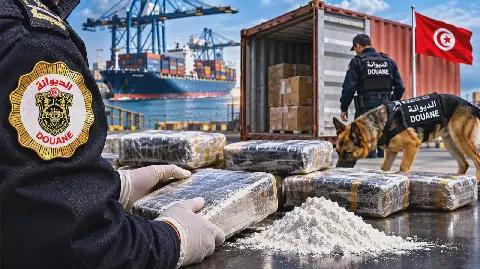
Tunisia has experienced a significant increase in cocaine seizures in recent years, with authorities seizing over 101 kilograms of the drug in the first nine months of 2026, compared to 94 kilograms in all of 2025 and 33 kilograms in 2024. According to officials, this rise is attributed to changes in smuggling routes, with Libya's unstable security situation making it an increasingly important transit point for cocaine bound for Europe.
The Tunisian Interior Ministry's head of narcotics, Mohamed Ali Chaouabi, stated that cocaine seizures have increased nearly 1,000-fold over the past decade, from just 150 grams in 2013 to over 140 kilograms in 2023. Chaouabi attributed part of this increase to trafficking through the 460-kilometer border with Libya, where "large quantities" of cocaine and other drugs are smuggled into Tunisia.
Libya's instability since the 2011 ousting of Muammar Gaddafi has made it a hub for smuggling, with the country providing an "alternative, cheaper and easier" route for trafficking cocaine and other drugs into North Africa and beyond. According to a UN report, Libya has become a "nascent hub for cocaine smuggling," particularly to Europe and the Middle East.
The UN report found that cocaine is smuggled into Libya via two main routes: by sea, with large shipments arriving directly from Ecuador, Colombia, and Brazil, and by land, with cocaine transported from West Africa through the Sahel region and into southern Libya. Armed groups in the Sahel provide protection for vehicles and trucks carrying cocaine in exchange for payments or a share of the drugs.
European authorities have reported that organized crime networks have increased their use of West African and North African routes following increased security measures in major European ports. The UN report also noted a "reverse flow" of cocaine from European ports, such as Marseille and Genoa, into Tunisian ports, where the drugs are hidden in cars or trucks on passenger and vehicle ferries.
The rise in cocaine seizures in Tunisia has also been driven by the country's strategic location, making it an attractive hub for smugglers. The price of cocaine in Tunisia is significantly higher than in Europe, which may provide an incentive for criminal networks to traffic the drug into the country. Tunisia's authorities are working to combat the issue, with Chaouabi emphasizing the importance of international cooperation and intelligence sharing to disrupt international trafficking networks.
The global production of cocaine reached an all-time high in 2024, with over 4,000 tons produced in South America, according to the UN's World Drug Report 2026. The report noted that cocaine has "penetrated retail markets" in North Africa, and that the region's location makes it an attractive hub for smugglers looking to redirect shipments to emerging markets in southern Europe, the East, and the Middle East.
Key points
- Tunisia's cocaine seizures have increased significantly in recent years, driven by shifts in smuggling routes and increased trafficking through the country's borders with Libya.
- Libya's instability has made it a hub for smuggling, with the country providing an alternative route for trafficking cocaine and other drugs into North Africa and beyond.
- The rise in cocaine seizures in Tunisia has also been driven by the country's strategic location, making it an attractive hub for smugglers.