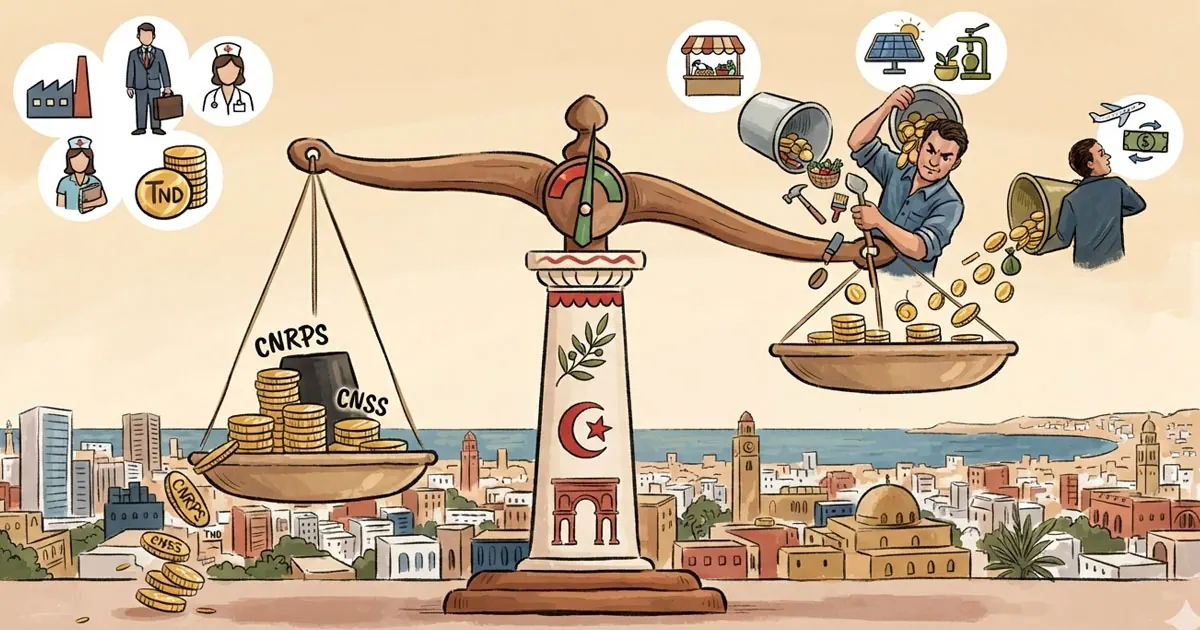
Tunisia's social security system is facing a significant challenge, with the combined deficit of its three main regimes approaching 7 billion dinars. This substantial figure raises questions about the sustainability of the current model, which has been in place for years. The country's demographic and economic landscape has undergone significant changes, with a growing elderly population, shifting workforce dynamics, and an increasing number of informal workers.
The issue is no longer just about financing the social security funds, but rather about the very architecture of the system. Previous solutions have focused on finding temporary fixes, such as new resources, budget transfers, and parametric measures. However, these measures are no longer sufficient to address the structural deficiencies in the system. As the ratio of active workers to retirees continues to decline, and careers become more fragmented, the financial equilibrium can no longer be maintained solely within the social security funds.
Experts argue that a fundamental transformation of the social security model is necessary. This involves rethinking the mechanisms of financing, coverage, solidarity, and governance, taking into account current economic and demographic realities. The social security system must be able to accommodate diverse professional trajectories, integrate new categories of workers, and better articulate social protection, employment, taxation, and financing. A comprehensive vision of social rights and future commitments is also essential.
The informal economy, which is often viewed as a source of lost tax and social security revenue, also presents an opportunity for growth. Many workers and activities in the informal sector could gradually be integrated into the social security system. To achieve this, realistic integration pathways must be created, including simplified procedures, adapted contributions, and clearly identified social rights. The goal is not to immediately formalize informal activities, but to create the conditions for a gradual transition.
Digitalization can play a crucial role in the overhaul of the social security system, but it must not be confused with reform itself. A unique social identifier, a social account to consolidate rights, and the interoperability of different agencies can improve governance. However, technology alone will not correct an unbalanced economic model. A coherent social architecture, with clear rules of governance, security, data protection, and accountability, must be established.
The 2026-2030 plan provides a strategic framework for this reform, but its success will depend on the ability to translate strategy into concrete decisions, projects, and measurable results. The 2027 budget will be a key test of the government's commitment to reform. The focus should be on creating a more transparent, predictable, and financially sustainable system. This will require robust governance instruments, including demographic and actuarial projections, scenario planning, and public indicators to track progress.
The demographic challenge is no longer just a social issue, but also an economic one. The aging population will put increasing pressure on intergenerational solidarity mechanisms, but it also presents opportunities for growth. By anticipating these changes, Tunisia can develop a more comprehensive policy response, incorporating employment, productivity, formalization, and fiscal and digital considerations. Ultimately, the goal is to create a more sustainable and equitable social security system that can adapt to changing economic and demographic conditions.
Key points
- Tunisia's social security system deficit approaches 7 billion dinars.
- The current social security model is unsustainable in its current form.
- A comprehensive overhaul of the social security system is necessary to address demographic and economic changes.