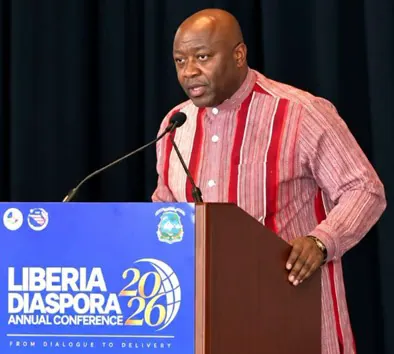
Liberia's Finance Minister Augustine Kpehe Ngafuan has reframed the diaspora's relationship with home, urging them to look beyond emotional appeals and consider investing in the country with a business mindset. Speaking at the recent Liberian Diaspora Conference in Washington, Ngafuan acknowledged that Liberia still faces significant challenges, including expensive electricity, poor infrastructure, and limited access to finance. However, he emphasized that the country is changing and that these changes are creating opportunities for Liberians willing to invest.
Ngafuan's message was clear: "Bet on Liberia." He presented economic numbers, infrastructure projects, and financial reforms to make a compelling case for investment. The minister highlighted Liberia's record of over two decades of peace and peaceful political transitions, as well as its growing international engagement, including its role as a non-permanent member of the United Nations Security Council. He also cited the country's economic growth, which reached 5.1 percent in 2025 and is projected to expand by 5.5 percent in 2026.
The minister pointed to several key sectors driving economic activity, including mining, construction, and manufacturing. He also noted that inflation averaged 4.5 percent during the first half of 2026, and the Liberian dollar has remained broadly stable. Ngafuan highlighted the government's efforts to improve financial management, including passing the national budget before the beginning of the fiscal year and improving the implementation of approved spending plans.
One of the government's strongest financial achievements is domestic revenue collection, which crossed the $1 billion mark for the first time by mid-September. Ngafuan attributed this growth to improved tax collection and financial management. However, he emphasized that this milestone is not the end of Liberia's financial problems, and the government still faces significant challenges in financing salaries, education, healthcare, security, infrastructure, and debt obligations.
Infrastructure development remains a major obstacle for businesses operating outside Monrovia. Ngafuan highlighted the government's ARREST Agenda, which includes plans to improve roads, agriculture, electricity, education, healthcare, sanitation, and tourism. The government has procured earth-moving equipment to support road maintenance across all 15 counties and is planning a 255-kilometer road network covering parts of Liberia's western and northern corridors.
Electricity remains one of Liberia's biggest development challenges, despite progress in increasing access to power. Ngafuan reported that electricity access has increased from 32 percent in 2024 to 40 percent in 2026. However, the cost and reliability of electricity remain critical issues for investors, determining whether a factory can operate or a small business can remain competitive.
The government is also promoting agricultural development, including deploying tractors to support farming and developing a Special Agro-Industrial Processing Zone in Buchanan. The facility is expected to support the processing of rice, cocoa, oil palm, fisheries products, and other commodities. This initiative aims to help Liberia move beyond exporting raw materials and create jobs and economic opportunities at home.
Key points
- Liberia's Finance Minister Augustine Kpehe Ngafuan has urged Liberians living abroad to invest in the country, citing economic growth and infrastructure development.
- The country's domestic revenue collection has crossed the $1 billion mark for the first time, driven by improved tax collection and financial management.
- Infrastructure development, including roads and electricity, remains a significant challenge for businesses operating in Liberia.