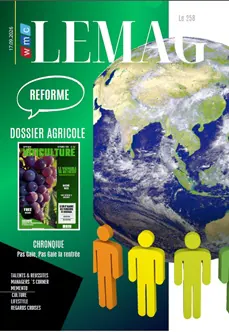
The latest issue of WMC LeMag, dated September 17, 2026, focuses on the challenges of implementing reforms in Tunisia. The publication highlights several sectors, including social security, public finances, and agriculture, where problems have been identified, but solutions are struggling to be executed. According to the magazine, the country's social security system is under pressure due to an aging population and a changing ratio of contributors to beneficiaries. With nearly 1.4 million pension beneficiaries, including around 800,000 retirees, the system's sustainability is a major concern.
The WMC LeMag issue presents various proposals to address these challenges, including reorganizing social security funds, diversifying financing sources, expanding coverage, and introducing fiscal solidarity mechanisms. However, the magazine also notes the limitations of relying solely on increased contributions or recruitment to achieve a balanced system. In the area of public finances, the 2027 budget project is seen as a key component of the 2026-2030 development plan, focusing on social justice, purchasing power, healthcare, and energy security.
The concept of economic sovereignty is central to the presentation of the 2027 budget project, which aims to promote national resource valorization, reduce dependencies, and enhance the economy's resilience to international crises. Another significant challenge discussed in the magazine is the issue of crossed debts, where the state, public enterprises, and private actors hold claims against each other, while some struggle with liquidity shortages. The publication suggests measures such as debt and claim registration, account rapprochement, and the integration of refundable tax credits.
The viticulture sector is also highlighted as an example of a structural problem affecting production capacity. According to data presented in the magazine, the area dedicated to winemaking has decreased from 14,500 hectares in 2003 to around 5,500-5,600 hectares. National production stands at approximately 150,000 hectoliters, while domestic consumption is estimated at around 200,000 hectoliters. The renewal of vineyards is identified as a major point of tension, with an estimated need for 15 million plants to restore 5,000 hectares of vineyards.
The WMC LeMag issue also covers other topics, including the energy transition and the challenges of achieving economic stability. The country's energy equation is seen as a critical factor in its economic stability. Additionally, the magazine discusses the issue of organ donation, with seven out of ten families refusing to allow organ harvesting.
In other news, a new solar power plant with a capacity of 300 MW and a battery storage system of 150 MW/540 MWh has been launched in Bazma-Kébili. The project aims to enhance the country's energy mix and reduce its reliance on fossil fuels. Furthermore, an initiative to reuse olive oil production byproducts as agricultural resources has been implemented in Zaghouan, with four new basins constructed for this purpose.
As Tunisia continues to navigate its economic challenges, the implementation of reforms remains a key priority. The country's ability to translate diagnoses into effective solutions will be crucial in addressing its various structural problems. With a focus on social security, public finances, and agriculture, the WMC LeMag issue provides a comprehensive overview of the country's reform efforts and the obstacles that need to be overcome.
Key points
- Tunisia's reform efforts face significant challenges in execution across various sectors.
- The country's social security system is under pressure due to an aging population and changing demographics.
- The implementation of reforms will require effective solutions to address the country's structural problems.