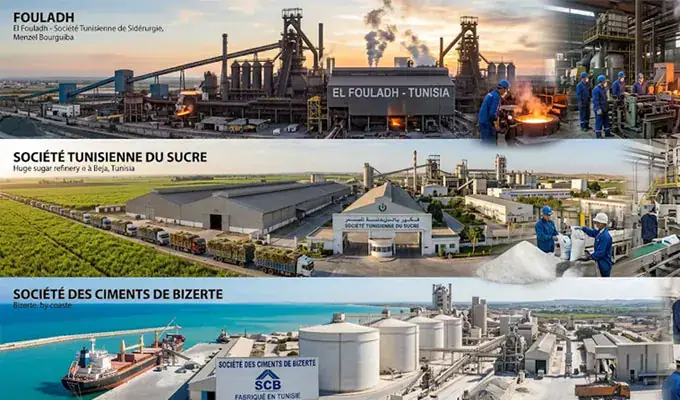
The Tunisian government has announced plans to restructure three public enterprises, with El Fouladh receiving a significant investment of $130 million for a new steel mill. The project, which aims to develop local production of steel billets and reduce dependence on imports, is currently under evaluation by the Islamic Development Bank (BID). The bank's approval is expected in April 2027.
The new steel mill project at El Fouladh is the largest investment among the three enterprises, with its cost estimative increasing from $70 million to $130 million to include the renovation of support units. The project aims to modernize the industrial sector and increase local production of steel billets. According to Minister of Economy Samir Abdelhafidh, the project's success depends on both the investment and its implementation.
Ciments de Bizerte, another public enterprise, is preparing an investment of 50 million dinars to improve energy efficiency and environmental protection. The company has also received a capital increase of 53.1 million dinars and a debt rescheduling. Unlike El Fouladh, Ciments de Bizerte has already begun its financial restructuring, and the focus now shifts to regaining market share and restoring financial equilibrium.
The Sucrerie de Béja, a sugar production company, plans to invest 40 million dinars in modernizing its equipment and acquiring essential installations. The company is also preparing a business plan and rescheduling its debts. The Sucrerie de Béja aims to produce 180,000 tonnes of raw sugar for refining and 171,000 tonnes of white sugar.
The restructuring of these three public enterprises illustrates different priorities, including mobilizing external financing, consolidating a recapitalized company, and restoring a productive tool. The success of these projects will be measured by their transformation into operational capacities, effective production, and sustainable financial equilibrium.
The Tunisian government's efforts to restructure public enterprises aim to improve their competitiveness and financial sustainability. The projects also reflect the government's commitment to developing the industrial sector and reducing dependence on imports. The Islamic Development Bank's involvement in the El Fouladh project highlights the importance of international cooperation in supporting Tunisia's economic development.
The outcome of these restructuring efforts will be closely monitored, as they have significant implications for Tunisia's economic growth and development. The government's ability to implement these projects successfully will be crucial in achieving its economic objectives and improving the competitiveness of its public enterprises.
Key points
- The Tunisian government has announced a $130 million investment in El Fouladh for a new steel mill, aiming to develop local production of steel billets and reduce dependence on imports.