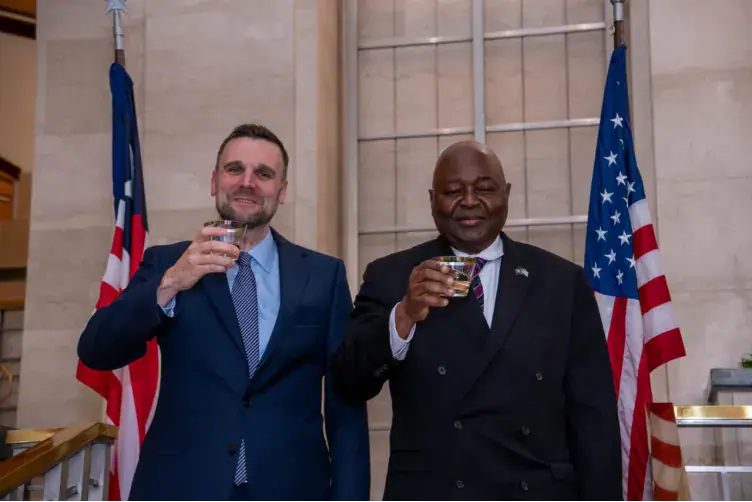
Liberian diplomats in Washington have received positive news regarding a potential second grant from the U.S. Millennium Challenge Corporation (MCC). On November 10, the MCC hosted a reception for a Liberian technical team working on the groundwork for a second MCC compact, a five-year grant that does not require repayment. Liberia's ambassador to the United States, Dr. Al-Hassan Conteh, highlighted the country's key challenges, including the need for cheap and reliable electricity, improved roads, governance, private-sector jobs, skills development, and environmental safeguards.
The MCC is a unique U.S. aid agency that does not provide loans, but rather grants to countries that meet specific eligibility criteria. To qualify, countries must pass at least half of 22 independent indicators covering governance, economic freedom, and investment in people. Liberia previously secured a $257 million compact, which focused on rebuilding the Mount Coffee Hydropower Plant, road maintenance, and power sector reform. The compact, which ran from 2016 to 2021, was deemed a success by MCC officials.
Liberia has been pursuing a second compact for nearly a decade, but faced setbacks due to governance issues and weak scores on key indicators. In December 2024, the MCC board selected Liberia as the only new country eligible to develop a compact that year. However, the process was delayed due to the Trump administration's review of foreign aid, which threatened to shut down the MCC. Liberia's compact survived, but the board postponed a decision on its continued eligibility in August 2025.
In December 2025, the MCC board reaffirmed Liberia's eligibility, and the country has since made progress in preparing for a second compact. A Compact Development Team, led by National Coordinator Alieu Fuad Nyei, was established to conduct a "constraints analysis" to identify the main obstacles to growth. The team, which recently visited Washington, has identified electricity and roads as top priorities. Finance Minister Augustine Ngafuan has estimated that the compact could be worth around $500 million.
A notable addition to the current compact is a mining project, which was not part of Liberia's first compact. The MCC has introduced new tests, including "America First" and "American Returns," which prioritize minerals and align with the current U.S. administration's interests. Liberia is building a framework for a state-owned National Minerals Company, and Monrovia appears to be pitching the compact in terms that align with Washington's priorities.
The MCC released its FY2027 scorecards, which show that Liberia has cleared both hard hurdles and the half-scorecard rule, but has weaknesses in areas such as child health, girls' primary education completion, women in the economy, and employment opportunity. Critics in Monrovia point to a contrast between the MCC scorecard and the State Department's Investment Climate Statement, which identifies corruption as a major obstacle to economic growth.
The MCC faces challenges in Washington, including funding cuts, a lack of private sector representation on its board, and a potential loss of quorum. The board's next meeting is scheduled for December, and the outcome will be crucial for Liberia's chances of securing a second compact. Liberia must continue to pass the scorecard and turn analysis into projects that can be financed, while Washington must maintain the MCC's budget and board functionality.
Key points
- Liberia is seeking a $500 million grant from the MCC to support infrastructure development.
- The MCC has introduced new tests, including "America First" and "American Returns," which prioritize minerals and align with the current U.S. administration's interests.
- Liberia must continue to pass the MCC scorecard and turn analysis into projects that can be financed to secure a second compact.
Reporting sources
- Liberia’s Long Wait for a Second U.S. Grant · FrontPage Africa