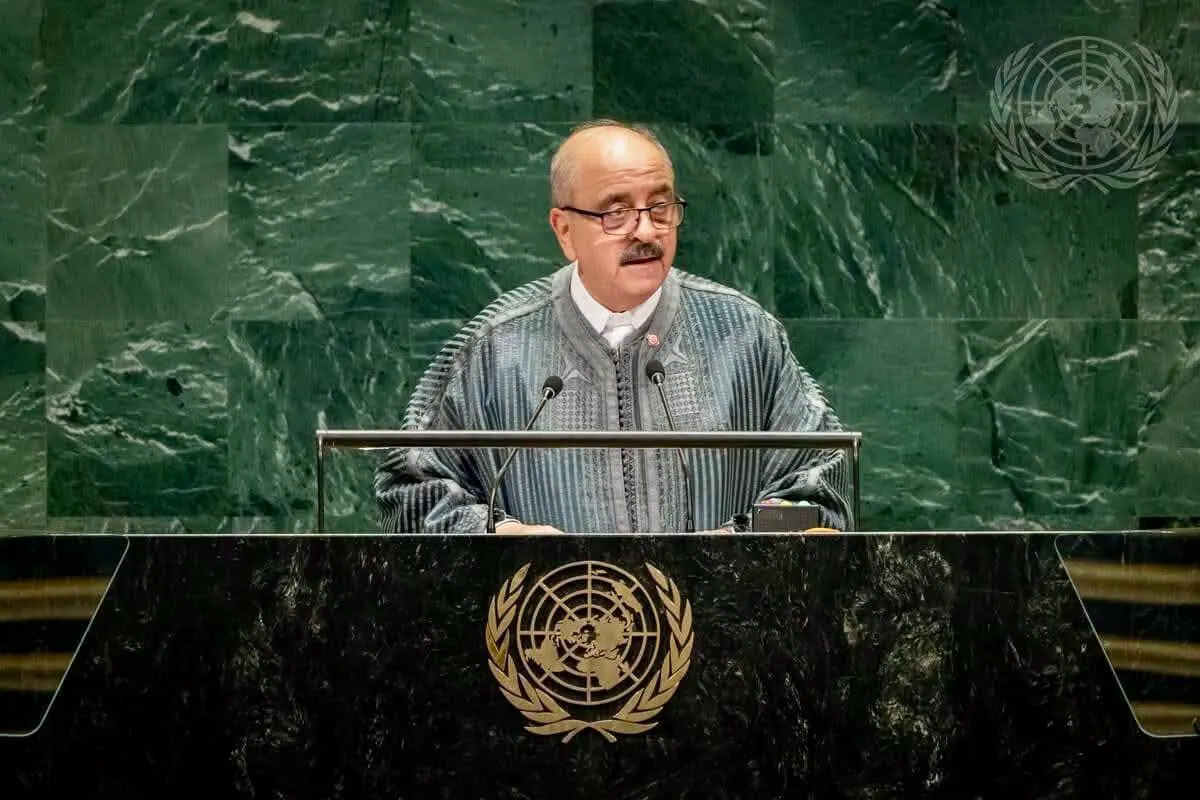
Tunisia's Foreign Minister, Mohamed Ali Nafti, addressed the 81st United Nations General Assembly in New York, highlighting the importance of restoring trust in the organization and multilateral work. He emphasized that this can be achieved through two essential conditions: genuine commitment and effective reform. Nafti expressed his congratulations to the newly elected President of the General Assembly and appreciation for the outgoing Secretary-General, António Guterres, for his efforts in promoting peace, security, and development.
Nafti praised Guterres for his courageous leadership in addressing unprecedented global crises, leaving a significant legacy of committed diplomacy and principled positions. He expressed hope that the next Secretary-General will be chosen based on their competence and ability to lead the organization with a strategic vision. The Minister also emphasized Tunisia's commitment to multilateral work, which dates back to the country's independence movement, and its role in promoting the Palestinian cause.
The Minister stressed that restoring trust in the organization requires a genuine commitment from all states to respect international law and the principles of the UN Charter. He emphasized the need for a comprehensive and profound reform of the organization to address the transformations in the world. This includes revising decision-making mechanisms to ensure more balanced and equitable representation, as well as greater transparency and accountability.
Nafti supported the "UN 80" initiative, which aims to promote reform and improve the organization's effectiveness. He emphasized the importance of preserving the international character of the organization and avoiding any measures that might undermine its credibility. The Minister also called for a fair and balanced approach to reform, ensuring that the organization's activities are not limited by financial constraints.
The situation in Palestine was a major concern for Nafti, who condemned the ongoing Israeli occupation and its consequences for the Palestinian people. He emphasized the need for the international community to assume its responsibilities and enforce international law. The Minister recalled the International Court of Justice's advisory opinion, which recognized Israel's obligation to end its occupation of Palestinian territory.
Nafti also highlighted the humanitarian crisis in Gaza and the need for safe and sustainable access to humanitarian assistance. He expressed concern about attempts to undermine the role of the UN Relief and Works Agency for Palestine Refugees (UNRWA) and emphasized the importance of preserving its mandate. The Minister reaffirmed Tunisia's support for the Palestinian people's legitimate rights, including their right to self-determination and statehood.
The escalation of tensions in the Middle East was another major concern for Nafti, who warned that the situation could have far-reaching consequences for regional and global security. He emphasized the need for a peaceful solution to the conflicts in the region and for the international community to work together to promote stability and prosperity. The Minister concluded by reaffirming Tunisia's commitment to multilateralism and its role in promoting peace and cooperation.
Key points
- Tunisia's Foreign Minister emphasizes the need for genuine commitment and effective reform to restore trust in the UN.
- The situation in Palestine and the humanitarian crisis in Gaza are major concerns for Tunisia.
- The Minister supports the "UN 80" initiative and calls for a fair and balanced approach to reform.