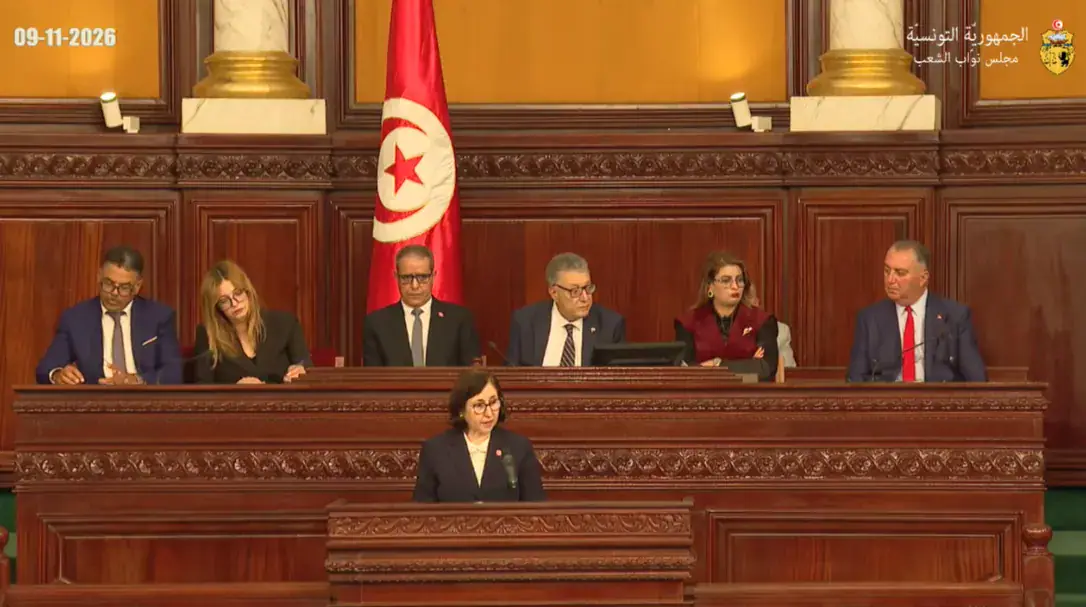
Tunisia's economy has shown signs of resilience in 2026, according to the country's Prime Minister, Sarra Zaâfrani Zenzri. During a plenary session of the Assembly of Representatives of the People (ARP) and the National Council for Economic and Social Development (CNRD), Zenzri stated that the economy has continued its recovery despite facing significant challenges. These challenges include external pressures, internal difficulties, and the legacy of past policies that have exhausted many public institutions and enterprises.
The execution of the 2026 budget took place in a complex international environment marked by uncertainty, slowing growth, rising inflation, and the crisis in the Middle East. The energy and raw materials markets experienced high volatility, increasing production, transportation, and insurance costs, which weighed heavily on public finances and enterprises. Domestically, exceptional heatwaves during the summer led to increased energy demand and put pressure on the electrical grid.
Zenzri attributed Tunisia's resilience to the strong performance of the agricultural sector, driven by better cereal and olive oil harvests, and the services sector, supported by the tourism industry's recovery. Key indicators of this recovery include a 2.4% GDP growth in the first half of 2026, with a projected 2.7% growth for the full year. The unemployment rate stood at 14.9% in the second quarter, slightly down from 15% in the first quarter.
Inflation in Tunisia has been relatively stable, with a cumulative rate of 5.3% as of September, down from 5.5% the previous year. The core inflation rate remained steady at 4.9%. Exports saw an 8% increase as of August, driven by energy, agri-food, and mechanical and electrical industries. Tourist revenues rose by 4.5%, reaching nearly 6.3 billion dinars, and transfers from Tunisians abroad increased by 5%, totaling 6.9 billion dinars.
The investment rate is expected to reach 15.5% of GDP, slightly up from 15.4% in 2025. Despite these positive indicators, the current account deficit is projected to widen to around 3.9% of GDP, up from 2.5% in 2025, primarily due to increased energy imports and commercial exchange pressures. The Prime Minister assured that Tunisia has met its external commitments on time, with foreign exchange reserves covering 93 days of imports as of October 23, 2026.
The Tunisian dinar has remained generally stable until the end of September, and the country's sovereign rating has been preserved. Inflation is expected to stabilize around 5.3%, indicating a relative control over prices. Zenzri emphasized that these results demonstrate a positive dynamic in national economic activity, enhancing the country's ability to adapt to economic changes and market fluctuations.
Looking forward, the Tunisian government aims to build on this momentum. The Prime Minister has expressed ambitions to change the governance model of public enterprises and has outlined plans for the 2027 budget, which includes a growth projection of 3.1% and a budget of 82.4 billion dinars. The government's focus on social welfare and economic stability is set to continue, with no planned tax increases.
Key points
- Tunisia's economy shows resilience with a 2.4% GDP growth in the first half of 2026.
- The country projects a 2.7% GDP growth for the full year 2026.
- Inflation is expected to stabilize around 5.3% for 2026.
Reporting sources
- La Tunisie confirme sa reprise progressive en 2026 malgré un contexte difficile · L'Économiste maghrébin