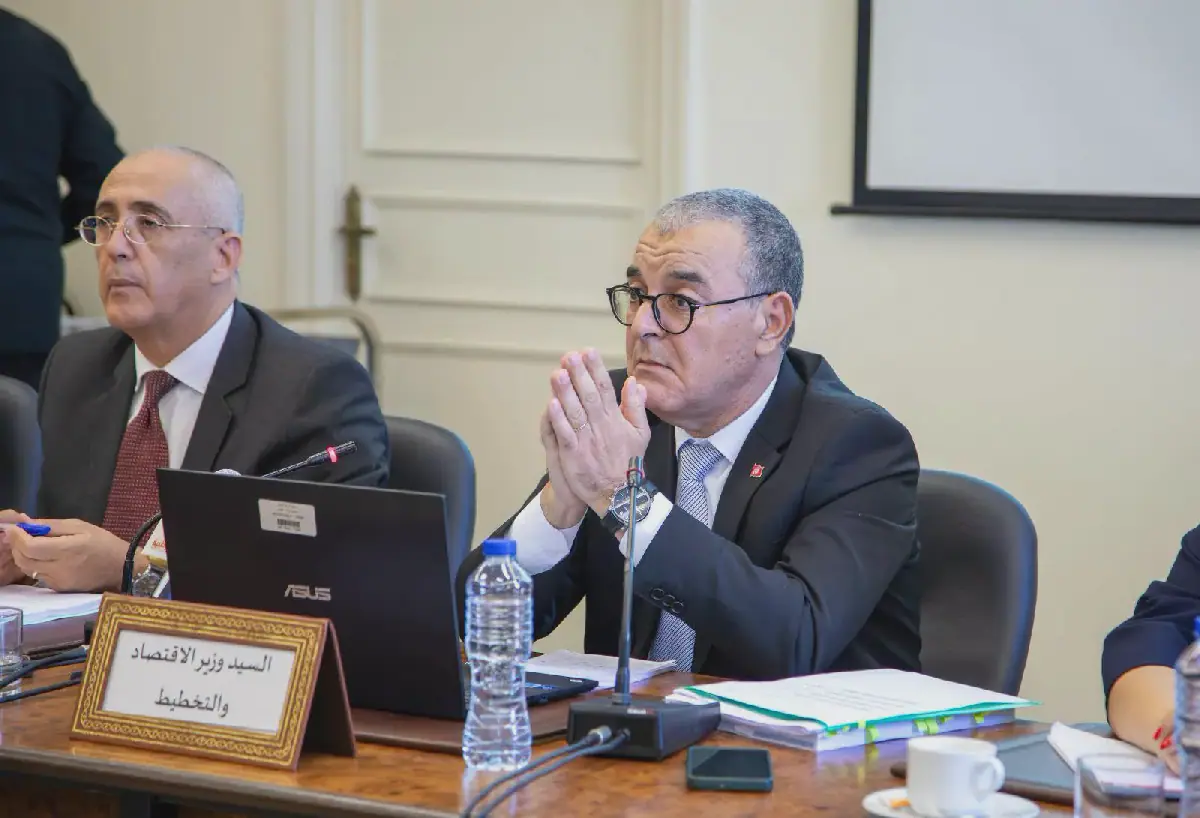
The Committee on Finance and Budget of Tunisia's National Council of Regions and Districts held a joint session with the Committee on Finance and Budget of the Assembly of People's Representatives on October 28, 2026. The meeting, attended by Committee Chair Ali Al-Hosumi and Minister of Economy and Planning Samir Abdel Hafiz, discussed the 2027 economic outlook. The committee emphasized the need to verify the realism of economic assumptions and their alignment with the 2026-2030 development plan.
The discussion focused on the consistency between the 2027 economic outlook and the finance bill for 2027, particularly regarding resource allocation, project financing, and deficit control. Members also raised concerns about balancing self-resource mobilization with external financing, seeking clarification on funding sources and their implications. They stressed the need for efficient management of public finances and directing resources toward productive investments that create jobs and improve basic services.
The committee also examined the situation of public institutions and enterprises, calling for a clear strategy to reform and restructure them. Members sought to improve governance, efficiency, and accountability in managing these entities. They emphasized the importance of transitioning from diagnosing difficulties to implementing effective reforms, simplifying procedures, and accelerating public contract execution to improve the business climate.
The discussion also touched on inflation and the informal economy, with members urging measures to combat rising prices, protect purchasing power, and integrate unorganized economic activities into the formal economy. They highlighted the need for a clear strategy to address structural imbalances in key sectors, such as phosphate, gypsum, energy, and export industries.
The committee reviewed the implementation of Law No. 18 of 2025, which provides exceptional provisions for recruiting highly qualified graduates who have been unemployed for an extended period in the public sector. Members also discussed the issue of frequent electricity outages and their impact on economic activity, industrial production, and daily life.
In the area of regional development, the committee emphasized the need to review public investment allocation policies to reduce regional disparities and prioritize projects with a direct impact on employment and living conditions. Members called for accelerating stalled projects, promoting local specificities and potential, and enhancing the role of local councils in preparing and monitoring development plans.
The Minister of Economy and Planning highlighted the importance of collaboration between the legislative and executive branches in addressing economic challenges and achieving development goals. He emphasized the need to maintain social gains while achieving economic reforms and balancing competing priorities.
Key points
- The 2027 economic outlook is under review by Tunisia's National Council of Regions and Districts.
- The committee emphasized the need for efficient management of public finances and directing resources toward productive investments.
- The discussion touched on inflation, the informal economy, and regional development, highlighting the need for a clear strategy to address structural imbalances.