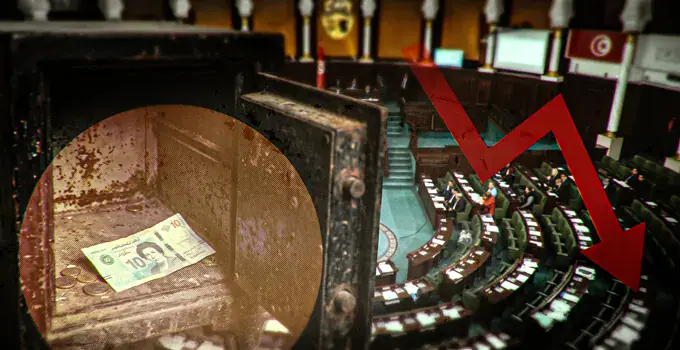
Tunisia's proposed 2027 budget plan has been criticized for not providing a clear solution to the country's economic crisis. The plan, which was recently announced, maintains high levels of public spending while increasing domestic borrowing. The government claims that the plan aims to achieve social justice, support investment, and ensure food, water, and energy security. However, critics argue that the plan does not address the root causes of the economic crisis.
According to the budget plan, state resources are expected to reach 54.280 billion dinars, while expenditures are projected to be 68.895 billion dinars. This leaves a significant gap of 14.615 billion dinars that needs to be financed. The government plans to finance this gap through domestic borrowing and a 9.8 billion dinar interest-free loan from the central bank. However, this approach has raised concerns about the country's growing debt and the potential risks to the banking system.
The budget plan also reveals that tax revenues will account for 91.4% of state resources, with a total of 49.6 billion dinars. However, the plan does not introduce significant reforms to the tax system, and critics argue that it does not do enough to address tax evasion and avoidance. The plan also includes measures to increase revenue from digital transactions and some minor adjustments to tax rates.
A comparison of the 2027 budget plan with the 2026 plan reveals a significant increase in expenditures, which are projected to grow by 8.37%. However, this growth is largely driven by increases in salaries and debt servicing costs. The plan also reveals that the government will continue to rely heavily on borrowing to finance its expenditures, which has raised concerns about the country's debt sustainability.
The budget plan has also been criticized for its limited allocation for investment and development projects. Despite the government's claims that it is committed to supporting investment and promoting economic growth, the plan allocates only a small fraction of resources to these areas. This has raised concerns about the country's ability to achieve its economic development goals.
The 2027 budget plan also highlights the risks associated with Tunisia's dependence on foreign financing. The plan assumes a price of $80 per barrel of oil, which may not be realistic given the current global economic trends. Any increase in oil prices could have significant implications for the country's budget and economy.
In conclusion, Tunisia's 2027 budget plan faces significant challenges, including a large gap between state resources and expenditures, a growing debt burden, and limited allocation for investment and development projects. While the government has claimed that the plan aims to promote economic growth and social justice, critics argue that it does not address the root causes of the economic crisis and may exacerbate the country's financial challenges.
Key points
- The 2027 budget plan reveals a significant gap between state resources and expenditures, which will need to be financed through domestic borrowing and foreign financing.
- The plan has been criticized for its limited allocation for investment and development projects, which may hinder the country's ability to achieve its economic development goals.
- The budget plan also highlights the risks associated with Tunisia's dependence on foreign financing and the potential impact of oil price fluctuations on the country's economy.