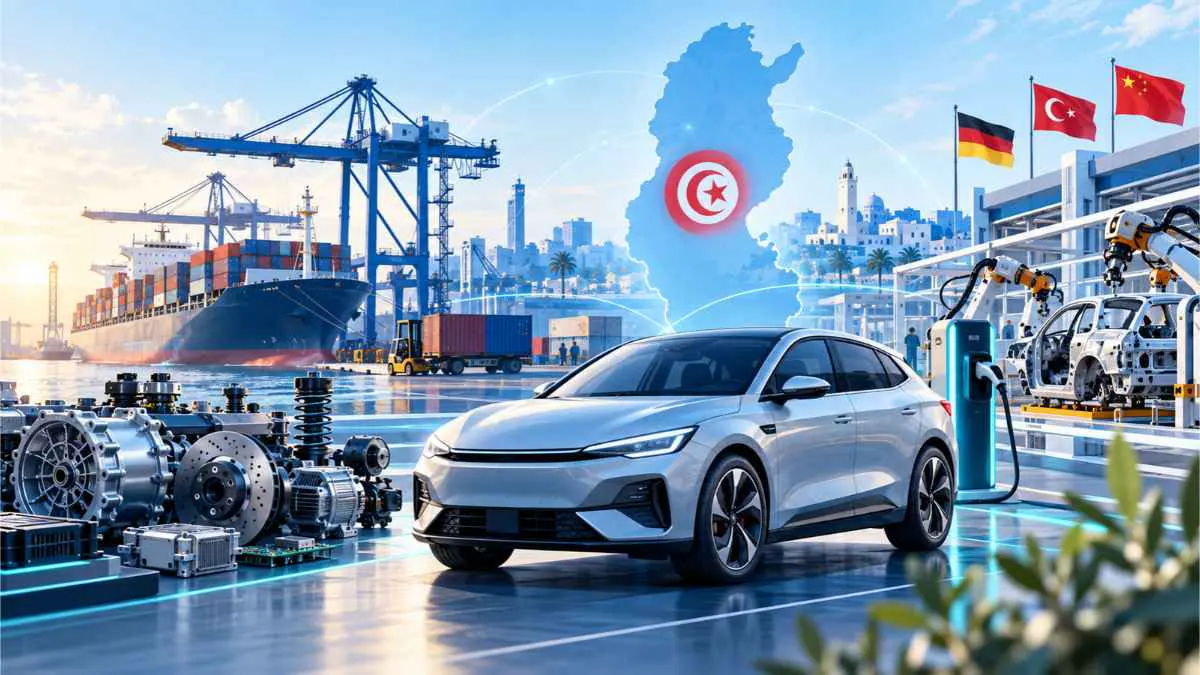
Tunisia's automotive industry has long been a significant contributor to the country's economy, with exports reaching approximately 3.9 billion euros in 2025 and employing over 120,000 people. The sector has traditionally relied on its proximity to Europe, competitive costs, and skilled workforce. However, as the industry evolves, Tunisia must adapt and develop a new strategy to remain competitive. The country's automotive sector has a strong foundation, but it needs to move beyond its current role as a low-cost production hub.
Germany has been a crucial partner for Tunisia's automotive industry, accounting for 37% of the country's automotive component exports. The two countries have a long-standing relationship, with German companies producing wiring, electronics, and other components in Tunisia for European markets. To strengthen this partnership, Tunisia aims to attract more engineering, product development, software, testing, and R&D activities from German companies. The Tunisian Automotive Management Academy, supported by the German Development Cooperation (GIZ), has already provided training to nearly 2,000 employees from German, European, and Tunisian companies.
Turkey offers a different opportunity for Tunisia, with a dense industry of suppliers that could support the development of the country's automotive sector. The two countries have a free trade agreement in place since 2005, which could facilitate the growth of trade. Tunisia can benefit from Turkey's expertise in producing automotive components, and the two countries can explore opportunities for co-production and local manufacturing of certain parts. Additionally, Turkey's experience in the aftermarket sector, including maintenance, distribution, and diagnostic services, could help Tunisia develop its own industry in this area.
China's dominance in the electric vehicle market presents both opportunities and challenges for Tunisia. In 2025, Chinese constructors accounted for 60% of global electric vehicle sales, and China produced nearly three-quarters of the world's electric vehicles. Tunisia can attract Chinese investors, like Taikang Electronics, which has already signed an agreement to establish a production facility in Sousse. However, the country must ensure that it does not merely become a market for Chinese vehicles and instead aims to localize activities, such as component production, electronics, and software development.
For Tunisia's automotive industry to succeed, the country must focus on developing its own capabilities and expertise. This involves shifting from component production to engineering, software development, and intellectual property creation. By doing so, Tunisia can retain more value within the country and move up the value chain. The government's priority should be to support this transition, ensuring that incentives for investors are tied to tangible results, such as job creation, skills transfer, and export growth.
A successful strategy for Tunisia's automotive industry will require a coordinated approach, leveraging partnerships with Germany, Turkey, and China. The goal is not simply to choose one partner over another but to create a comprehensive strategy that maximizes value creation in Tunisia. By working with these partners, Tunisia can secure production, develop its supplier base, accelerate electrification, and become a hub for high-value-added activities.
Ultimately, the question for Tunisia is not which partner to choose but how to retain more value within the country. By focusing on engineering, software development, and intellectual property creation, Tunisia can build a more sustainable and competitive automotive industry. The country's experience and expertise in the sector provide a solid foundation, but it is crucial to adapt and evolve to remain relevant in the rapidly changing global automotive landscape.
Key points
- Tunisia aims to strengthen its automotive sector through strategic partnerships with Germany, Turkey, and China.
- The country seeks to move beyond low-cost production and develop higher-value-added activities, such as engineering, software development, and intellectual property creation.
- A successful strategy will require a coordinated approach, leveraging partnerships to secure production, develop the supplier base, accelerate electrification, and create high-value-added activities in Tunisia.