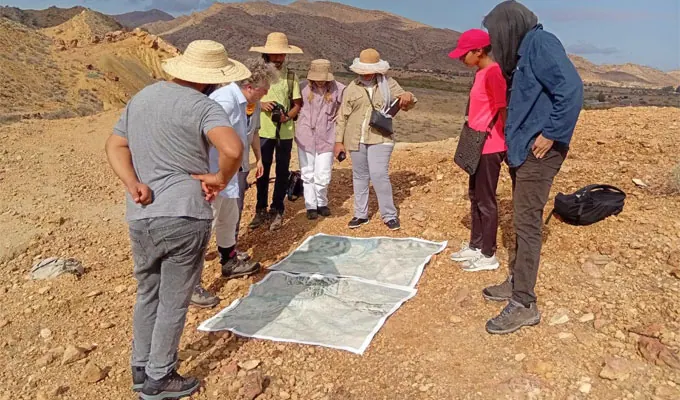
The Tunisian National Heritage Institute (INP) and the University of Cambridge have initiated a collaborative archaeological research program in the governorates of Kairouan and Le Kef. The project aims to reconstruct the history of human societies and their occupation of the territory between the third and the beginning of the first millennium BC. This program is part of an international cooperation agreement.
The research is being conducted in the watersheds of Oued Zeroud in Kairouan and Oued Tessa in Le Kef. The project involves a comparative approach between two distinct environmental settings: the semi-arid steppe and the semi-humid tell region. The goal is to investigate the interactions between early agricultural societies and their environment, as well as their strategies for exploiting natural resources.
The first phase of the research focuses on the lower basin of Oued Zeroud and the sector of Oued Khanguet Afres, between Zouarine and Le Sers. The teams are revising the chronology of several archaeological remains, particularly funerary structures previously attributed to the Numidian period. However, the absolute dating of these structures remains to be established.
The research teams are employing a methodology that combines intensive surveys and cutting-edge technologies. This includes 3D photogrammetry using drones, differential GPS topographic surveys, and sampling for geomorphological and archaeobotanical analyses, as well as radiocarbon dating. These investigations aim to fill gaps in the historical record due to the rarity of sites with well-defined stratigraphic sequences.
The program seeks to refine the chronology of human occupation in these two regions and better understand the evolution of ancient societies in response to environmental constraints and resources. By studying the interactions between early agricultural societies and their environment, researchers can gain insights into the strategies used by ancient communities to adapt to their surroundings.
The archaeological program is expected to contribute significantly to the understanding of human occupation in Tunisia during the 3rd to 1st millennia BC. The project's findings will provide valuable information on the evolution of societies in the region and their relationships with the environment. This knowledge will help to contextualize the history of human societies in Tunisia and the broader Mediterranean region.
The collaboration between the INP and the University of Cambridge highlights the importance of international cooperation in archaeological research. The project's use of advanced technologies and multidisciplinary approaches sets a new standard for archaeological research in Tunisia and demonstrates the potential for innovative research in the region.
Key points
- The program aims to study human occupation in Kairouan and Le Kef from the 3rd to 1st millennia BC.
- The research involves a comparative approach between semi-arid and semi-humid environments.
- The project uses advanced technologies, including 3D photogrammetry and radiocarbon dating.