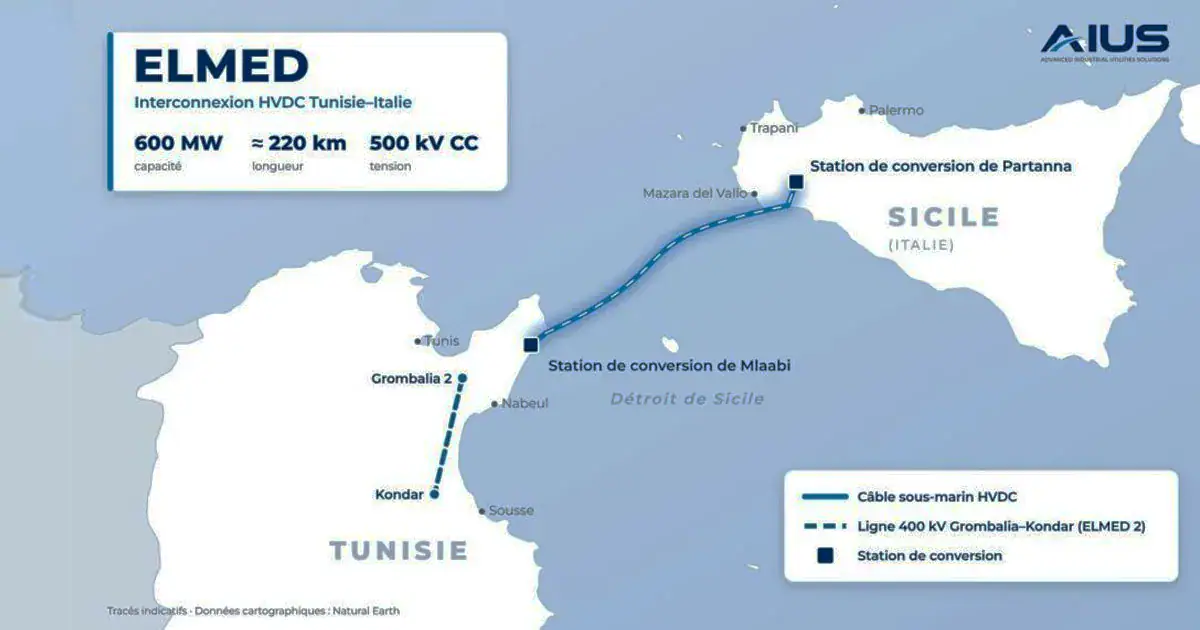
The Elmed project, which aims to link Tunisia and Italy via the Strait of Sicily, will have a bidirectional capacity of 600 megawatts and is estimated to cost around 1.42 billion euros. The project involves the construction of converter stations and an underwater cable, and its commissioning is currently scheduled for between 2028 and 2030. The interconnection will enable the exchange of electricity between the two countries, allowing Tunisia to export renewable energy to the European market and import energy from Italy if needed.
The main contracts for the project have been awarded, with Hitachi Energy winning a contract worth around 770 million euros to build the two converter stations. The stations will be located in Mlaabi, Tunisia, and Partanna, Sicily. The contract for the underwater cable, which will stretch for approximately 200 kilometers, has been awarded to Italian group Prysmian for around 460 million euros. These developments mark a significant step forward in the implementation of the Elmed project.
The Elmed project also includes a second phase, known as Elmed II, which focuses on strengthening Tunisia's national grid. This phase involves the construction of a high-voltage overhead line between Grombalia and Kondar, as well as additional connecting lines. The project aims to facilitate the integration of new renewable energy sources and improve the transmission of electricity across the country. To support this phase, a financing agreement worth 43 million euros was signed between Tunisia and the European Bank for Reconstruction and Development (EBRD) in January 2026.
The EBRD financing agreement, which includes a guarantee from the Tunisian state, will be repaid over 18 years, with a five-year grace period. The loan will support the implementation of Elmed II, which will cover several governorates in Tunisia, including Nabeul, Ben Arous, Zaghouan, and Sousse. The project has received backing from several international donors, including the European Union, the World Bank, and the German KfW institution.
The Elmed project is a strategic element of cooperation between Italy and Tunisia, aiming to strengthen energy integration between the two countries and promote the development of renewable energies in Tunisia. The interconnection will enable Tunisia to export electricity produced from renewable sources to the European market, while also allowing for imports from Italy if needed. This project is part of a broader effort to integrate the North African and European electricity markets.
The project has been making progress, with the Tunisian parliament recently receiving a bill related to the project's financing. The bill, which was transmitted to the parliamentary finance committee on November 2, seeks to approve a guarantee convention for the EBRD loan. The Elmed project is expected to have a significant impact on Tunisia's energy sector, enabling the country to better integrate renewable energy sources and improve its energy security.
The Elmed project's success is crucial for Tunisia's energy future, as it will enable the country to harness its renewable energy potential and integrate it into the European market. With the awarding of major contracts and the progress made on the financing front, the project is entering a decisive phase. Key stakeholders, including the Tunisian government, the EBRD, and the European Union, are working together to ensure the project's successful implementation.
Key points
- The Elmed project will have a bidirectional capacity of 600 megawatts and is estimated to cost around 1.42 billion euros.
- The project involves the construction of converter stations and an underwater cable, with Hitachi Energy and Prysmian winning major contracts.
- The Elmed project aims to strengthen energy integration between Tunisia and Italy, promote renewable energies in Tunisia, and improve the country's energy security.