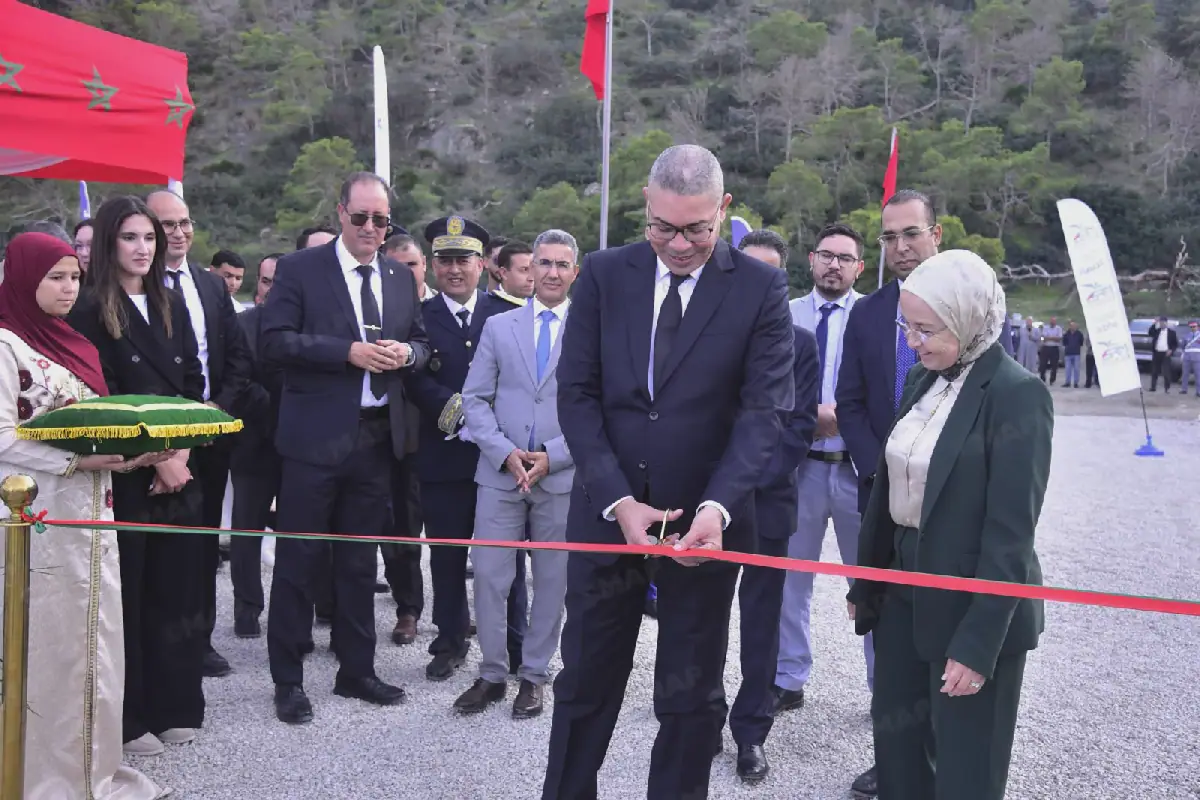
The Regional Multiservice Company (SRM) of Tanger-Tetouan-Al Hoceima has launched a seawater desalination plant in Jebha, Chefchaouen province. The plant was inaugurated on the 51st anniversary of the Green March and the first anniversary of Unity Day. Governor Zakaria Hachlaf attended the ceremony alongside local authorities, elected officials, and institutional partners. The project aims to strengthen water security and diversify drinking water sources in the region.
The Jebha desalination plant required an investment of approximately MAD 13 million ($1.3 million), financed by the Ministry of Interior, with SRM acting as the delegated project manager. The facility will produce around 864 cubic meters of desalinated water per day, or 10 liters per second. This will serve about 14,500 people, mainly in the communes of Jebha and Amtar, while improving local supply conditions.
The plant relies on a compact reverse osmosis unit and includes a borehole with a flow of 24.3 liters per second, pipelines for raw and treated water, annex structures, and a connection to the power grid through a dedicated transformer. The treatment process involves several stages, including filtration and pretreatment, reverse osmosis, remineralization, and final disinfection, designed to meet quality standards for human consumption.
The Jebha launch reflects Morocco's strategy to quickly scale up its desalination capacity. Over five years, the country has doubled its number of plants, moving from nine stations in 2021, with 46 million cubic meters a year, to seventeen in 2026, with 447 million cubic meters. By 2031, Morocco aims to produce 1.8 billion cubic meters annually, split almost evenly between drinking water for cities and irrigation.
The National Program for Drinking Water Supply and Irrigation (PNAEPI) 2020-2027 centers on unconventional water resources, including desalination. Minister of Equipment and Water Nizar Baraka recently announced a new water security strategy that accounts for climate shifts, drought, flooding, rising temperatures, and irregular rainfall. The strategy includes launching new desalination plants, such as those at Nador, Driouch, and Tangier.
While desalination has carried heavy costs and environmental concerns, demand persists among farmers facing years of drought and falling groundwater. A recent report by Le Monde documented the high costs of desalination in the Souss-Massa region, where a cubic meter of water sells for MAD 5.60 ($0.56), against MAD 1.50 ($0.15) for dam water. The gap is covered by state subsidies, which Morocco's Court of Auditors warned could create a deficit of MAD 9 billion ($900 million) over 27 years.
Despite the challenges, officials expect the Jebha station to reduce distribution disruptions and improve service reliability during periods of high demand. The project aligns with royal directives to mobilize available resources and accelerate projects that address water stress and climate change. As Morocco continues to expand its desalination capacity, it aims to cover 60% of the kingdom's drinking water needs by 2031.
Key points
- The Jebha desalination plant will produce 864 cubic meters of water daily, serving 14,500 people in Chefchaouen.
- Morocco aims to produce 1.8 billion cubic meters of water annually by 2031, split between drinking water and irrigation.
- The country has doubled its number of desalination plants over the past five years, from nine to seventeen.