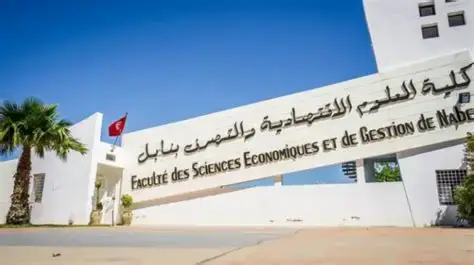
The second international conference of the Faculty of Economic Sciences and Management in Nabel, Tunisia, kicked off on Friday, October 30, 2026, in Hammamet, Nabel Governorate. The event gathered a number of university professors from Tunisia, Algeria, France, Morocco, Egypt, Jordan, and several researchers, including master's and Ph.D. students, and representatives from various economic institutions.
The conference focused primarily on governance and sustainability, with participants set to explore the relationship between the two themes, as well as their impact on economic challenges. According to Anis Ben Abdallah, Dean of the Faculty of Economic Sciences and Management in Nabel, the conference would delve into various lectures and discussions on the transformations in geopolitics, climate change, and technological and economic changes.
The conference began with a roundtable discussion on the topic of financing, given the close relationship between financing and general development, as well as sustainable development. The transformations in geopolitics pose significant challenges for Tunisia, particularly in mobilizing financing and exporting products.
The conference provided an opportunity for participating researchers to present their research and findings to a group of professors and experts. This exchange would facilitate an in-depth discussion on the latest scientific research and its requirements, including the use of artificial intelligence in research and adherence to ethical standards.
According to Ben Abdallah, the conference aimed to produce a set of practical recommendations that could be used to achieve sustainable development, particularly in financing and economic models that can address the challenges posed by geopolitical transformations, climate change, and technological and social changes.
Khalid Hosseini, a professor of accounting at the University of Bangor in the United Kingdom, participated in the conference with a lecture on corporate governance and its impact on performance evaluation and financial performance of companies and banks. He emphasized the need to apply modern technological methods to achieve sustainability.
The conference concluded with a focus on the importance of governance and sustainability in achieving economic development and social responsibility. The participants highlighted the need for a high-quality governance system that promotes trust, transparency, and long-term goals in a rapidly changing world.
Key points
- The conference focused on governance and sustainability, with a particular emphasis on financing and economic models.
- The event brought together academics and researchers from across the globe to share their research and findings.
- The conference aimed to produce practical recommendations for achieving sustainable development.