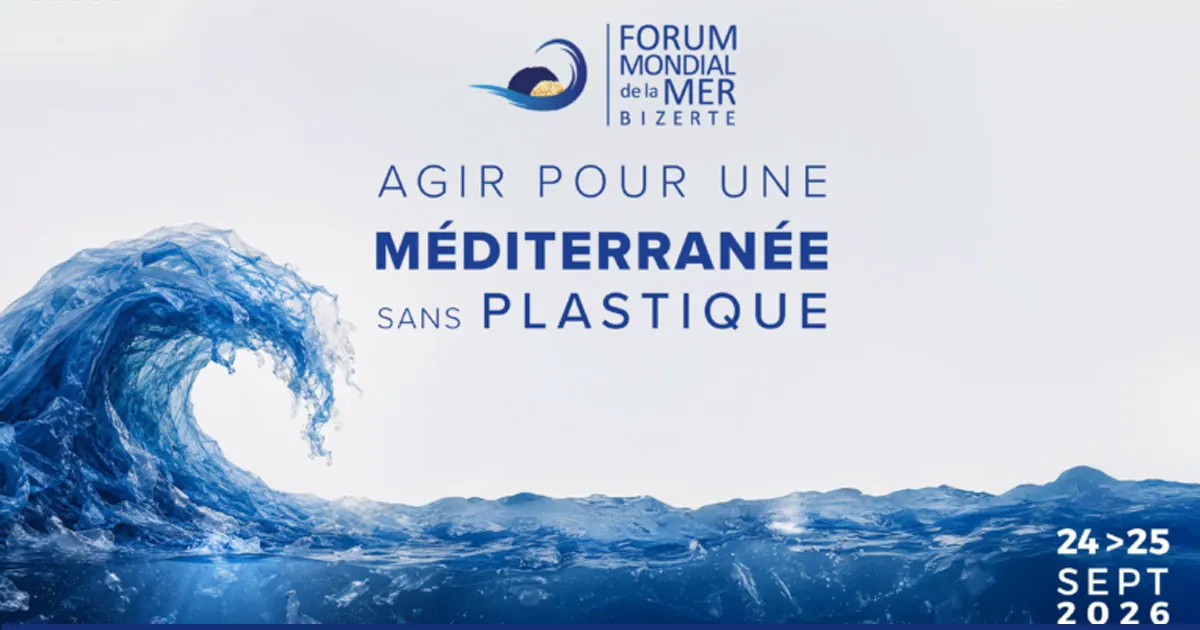
The ninth edition of the Bizerte Sea Forum kicked off on September 24, 2026, in the northern Tunisian port city of Bizerte. The two-day event, themed "Acting for a Plastic-Free Mediterranean," brings together scientists, local officials, diplomats, businesses, and civil society to address the pressing issue of plastic pollution in the Mediterranean. Organized under the Interreg Next Med program, the forum aims to transform dialogue into structured cooperation and concrete solutions to a problem that knows no national borders.
The Mediterranean is particularly vulnerable to plastic pollution, accounting for only 1% of the world's oceanic surface but concentrating around 7% of global microplastics. Approximately 230,000 tons of plastic waste end up in its waters annually, threatening an ecosystem that is home to around 17,000 endemic species. With global plastic production estimated at 500 million tons in 2024 and projected to double by 2050, the need for urgent action is clear. The forum's organizers hope that the region's unique vulnerability will spur more extensive cooperation, even in the absence of a binding international agreement.
The forum coincides with ongoing negotiations for an international treaty to combat plastic pollution, launched by the United Nations in 2022. However, progress has been slow, and the absence of a binding agreement has not deterred the organizers from pushing for concrete actions. Pascal Lamy, president of the Bizerte Sea Forum, described the Mediterranean as "the sentinel of the planet," capable of sounding the alarm on ecosystem degradation. Rym Benzina, president of La Saison Bleue and forum director, emphasized the goal of making the event a working platform for authorities, scientists, entrepreneurs, and civil society.
The first day of the forum, September 24, focuses on territorial cooperation, featuring the presentation of the Share4Med project and an workshop with Tunisian and Mediterranean municipal representatives. The aim is to develop an action plan for the coalition of Mediterranean cities and introduce tools for coastal managers to assess pressures on coastlines. The launch of the Circe.med association is also announced, further solidifying the region's commitment to addressing plastic pollution.
On September 25, discussions will delve into the future global treaty on plastic pollution, as well as roundtable discussions on the state of scientific research and potential solutions by 2030. Participants include representatives from Tunisian organizations INSTM and Apal, France's Ifremer, the Sorbonne, MedPAN, the Blue Plan, and the WWF, among others. The forum provides a platform for experts to share knowledge and explore collaborative solutions to mitigate the impact of plastic pollution.
The forum will also examine the economic implications of plastic pollution on tourism, urban development, and the circular economy. Discussions will cover the positions of Mediterranean countries and the European Union, as well as financing mechanisms for the ecological transition. One initiative announced is the Plastic Credit Exchange, designed to contribute to the financing of green infrastructure. The Share4Med project, co-financed by the EU, aims to support municipalities in developing sustainable coastal projects.
The Bizerte Sea Forum, launched in 2018 by La Saison Bleue, has established itself as a key regional event on maritime issues on the southern Mediterranean coast. As the region continues to grapple with the challenges of plastic pollution, the forum's emphasis on cooperation and concrete action offers a glimmer of hope for a more sustainable future. With its diverse range of participants and focus on practical solutions, the event aims to drive meaningful change in the fight against plastic pollution.
Key points
- The Bizerte Sea Forum aims to make the Mediterranean a regional laboratory for combating plastic pollution.
- The Mediterranean concentrates around 7% of global microplastics despite accounting for only 1% of the world's oceanic surface.
- The forum's organizers hope that the region's unique vulnerability will spur more extensive cooperation to address plastic pollution.